No. 05
The Database Idea IBM Could Not Afford to Build
In 1970, Edgar Codd gave IBM the blueprint for the modern database. They sat on it for 13 years. Oracle read the same paper and built a…
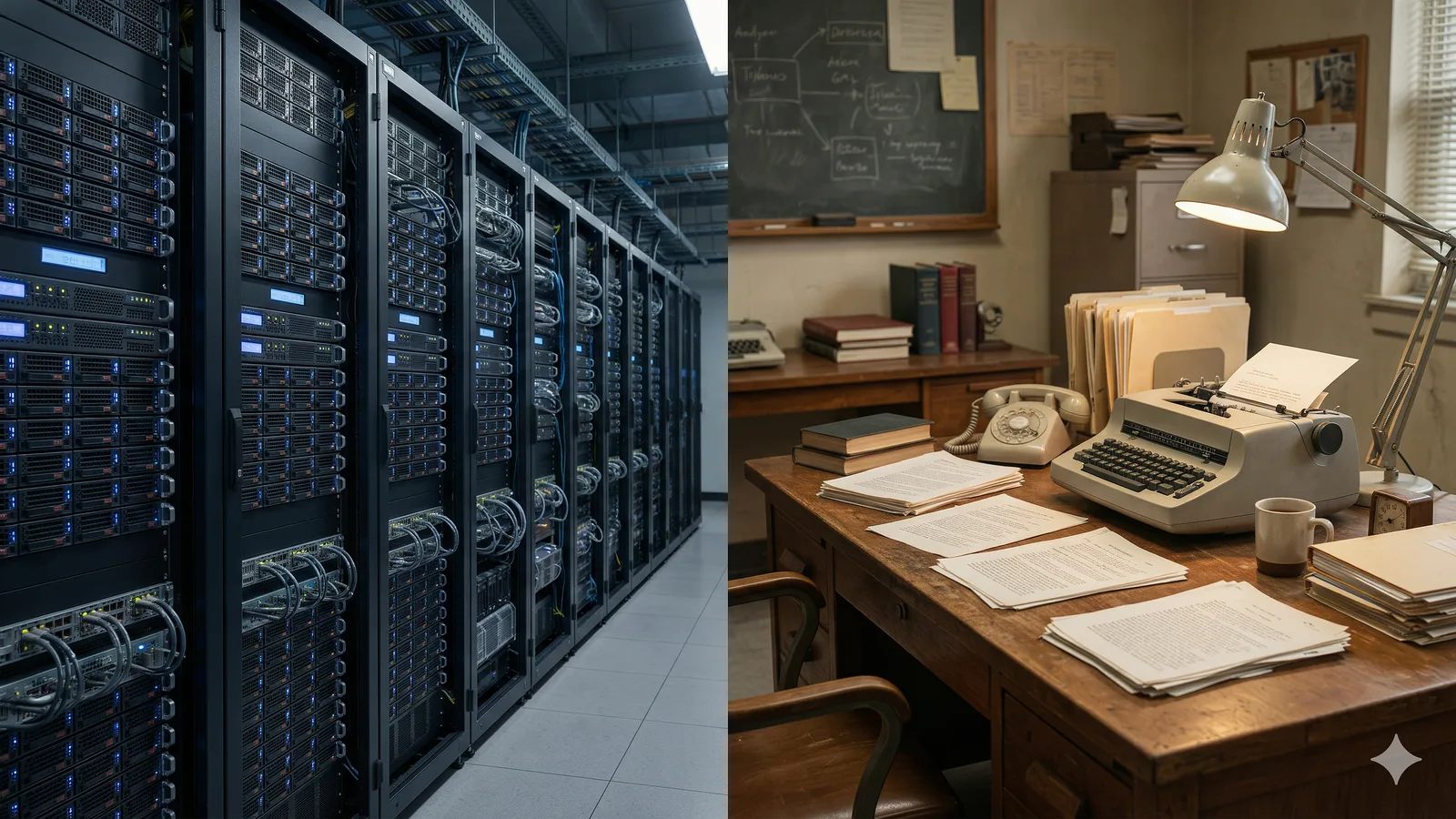
Right now, while you are reading this article, somewhere in the world a bank is processing a transaction, a hospital is retrieving a patient record, an airline is confirming a seat assignment, and a retailer is updating an inventory count.
Each of these operations runs against a database. Nearly every database they use, from the smallest company server to the largest cloud installation on the planet, is built on a single idea that one man described in twelve pages in June 1970.
His name was Edgar Frank Codd. He worked for IBM. IBM did not want to use his idea.
The company, founded seven years later in a rented office in California with $2,000 in starting capital, did. That company went on to become Oracle. It is worth more than $400 billion today.
This is the story of how the most important idea in the history of data storage was written, buried, stolen by nobody, and built into an empire by the people who simply bothered to read it.
The RAF Pilot
In 1942, a nineteen-year-old mathematics student from Dorset named Edgar Frank Codd left Oxford University to fly for the Royal Air Force. He was assigned to Coastal Command and spent the next four years piloting Sunderland flying boats over the North Atlantic, hunting German submarines in some of the most dangerous patrol routes of the war.
He returned to Oxford in 1946, finished his degree, moved to New York, and joined IBM in 1949 as a mathematical programmer working on the company’s most powerful machines.
He was exactly the kind of man IBM wanted in 1949: technically brilliant, methodical, comfortable with uncertainty. He stayed for four years. Then he left.
In 1953, Codd resigned and moved his family to Ottawa. He had grown disgusted with what McCarthyism was doing to public life in the United States, and he was not willing to work in that climate. He spent the next four years in Canada.
He returned to IBM only after a chance meeting with a former manager who persuaded him to come back. By the time he arrived at the company’s San Jose Research Laboratory in 1968, he was forty-four years old, had spent four years hunting submarines over the Atlantic, and had already quit IBM once on principle.
San Jose gave him time to think about a problem nobody had asked him to solve.
Databases.
In 1968, every large database in the world operated on what engineers called the hierarchical model. Data was stored as a tree: a root record at the top, child records branching below it, grandchildren below that.
If you wanted to find information, you followed the branches. You had to know the physical structure of the tree before you could ask it anything. Change the structure, and every program written to query it breaks.
IBM built its own hierarchical database in 1966, while working under a NASA contract for the Apollo space program. It was called IMS, Information Management System, and it had been designed to track the millions of parts in a Saturn V rocket. It was enormously complex, it worked, and by 1968 large corporations across America were paying IBM to run their businesses on it.
Codd thought the whole approach was wrong.
He had a PhD in mathematics from the University of Michigan. He studied set theory and predicate logic, the mathematical structures that underpin formal reasoning. He could see, sitting in his San Jose office, that databases did not need to be trees at all.
Data had a natural structure that was much simpler: tables. Rows and columns. Relations between tables. A user should be able to ask a question, any question, without knowing how the data was physically arranged on the disk.
He called this idea the relational model. In August 1969, he wrote it up as an internal IBM research report, nineteen pages long, and circulated it inside the company.
IBM noted it and moved on.
Twelve Pages
In June 1970, Codd published a revised version of his internal report in the Communications of the ACM, the Association for Computing Machinery’s journal, the most widely read publication in computer science.
He titled it “A Relational Model of Data for Large Shared Data Banks.” It ran to twelve pages.
What he proposed sounded almost too simple. Store data in tables. Each table has rows and columns. Columns represent attributes: a customer’s name, an order number, a product price. Rows represent records. Tables relate to one another through shared columns, without any physical pointer connecting them.
A query language, Codd called it a relational algebra, could then extract any combination of information from any combination of tables in a single operation.
The user did not need to know where the data lived on disk. The database managed that. Describe what you want. The system finds it.
Before Codd, a programmer writing a query had to work through the physical tree of the data, branch by branch. Codd’s model made the physical storage invisible. The programmer described the result. The database found it.
His IBM colleague Chris Date, who would later become Codd’s closest collaborator, described what this meant before Codd arrived: databases were, in his words,
“completely ad hoc and higgledy-piggledy.” After Codd’s paper, they had a mathematical foundation. “Codd’s biggest overall achievement,” Date said, “was to make database management into a science.”
Researchers at universities across the United States and Europe read the paper immediately. At Berkeley, a team began building a prototype called Ingres. At IBM’s own San Jose lab, researchers began talking about building a prototype to prove the concept worked at scale.
Inside IBM’s product division, the response was different.
The Product IBM Could Not Afford to Build
IBM’s IMS database was not just a product. By the early 1970s, it was a revenue engine. Hundreds of large corporations, banks, airlines, manufacturers, had built their operations on it. They were paying IBM licensing fees.
Their programmers had been trained on it. The data was stored in a hierarchical structure. Switching to a new database model would mean retraining staff, migrating data, rewriting every application that touched the database. The switching cost was IBM’s protection.
Codd’s relational model, if IBM commercialised it, would have made IMS obsolete. Customers might migrate. Revenue would be at risk. The internal opposition was not quiet about it.
Harwood Kolsky, a physicist who had worked alongside Codd at IBM since the 1950s, described the atmosphere in an interview after Codd’s death. “His approach was not, shall we say, welcomed with open arms at IBM. It was a radical approach.”
The ACM Turing Award citation for Codd, published in 1981, was more precise: IBM was “initially quite unreceptive, not to say hostile, to Codd’s relational ideas.”
The hostility was not abstract. It came from people whose product Codd was proposing to replace, and who had the company’s revenue figures on their side.
IBM did not kill the relational model. It did something more damaging. It allowed it to exist as research without ever committing to commercialise it.
In 1974, IBM’s San Jose lab launched System R, a prototype relational database designed to prove Codd’s model could work in practice. System R was real engineering.
It produced SQL, a query language invented by IBM researchers Donald Chamberlin and Raymond Boyce, originally called SEQUEL, which every relational database in the world still uses today. By 1976, IBM had published the System R research papers. By 1978, System R had run in live customer environments. It worked.
IBM then spent another three years deciding what to do with it.
IBM had the mathematical theory. A working prototype. The query language. Customer results. All of it sat in research limbo while the IMS product division held the company’s attention. IBM released SQL/DS, its first commercial relational database, in 1981. Its flagship product, DB2, shipped on June 7, 1983.
By then, Oracle had been in the market for four years.
The Man Who Read the Paper
Larry Ellison was thirty-one years old in 1976. He had dropped out of two universities, drifted through a succession of programming jobs across California, and had most recently been working at a company called Ampex Corporation in Sunnyvale, a data storage firm, before moving to a small company called Precision Instruments. He had landed at each of them, as he later said, with no particular plan.
At Ampex, he had read Codd’s 1970 paper.
He also read the IBM System R research papers when IBM published them in 1976. IBM had, in its thoroughness, documented exactly how a relational database should be built, what query language it should use, how the optimizer should work. IBM published this because it was research. Research was meant to be shared.
Ellison saw something IBM did not: a business.
In 1977, Ellison and two colleagues he had met at Ampex, Bob Miner, a gifted software engineer who would write most of the working code, and Ed Oates, a programmer, left their jobs and incorporated a company called Software Development Laboratories in Santa Clara, California. Their starting capital was $2,000. Ellison contributed $1,200.
Their first contract came from the Central Intelligence Agency, which needed a database system for a classified project. The CIA had already given the project a codename: Oracle. Ellison and Miner built what the CIA needed, then spent the following year turning it into a commercial product. They named it after the contract.
Oracle Version 2 shipped in 1979. They had skipped Version 1 entirely, worried that the label would signal immaturity to customers. It ran on DEC minicomputers, which were cheaper than IBM mainframes and spreading fast through corporate America. It was the first commercial relational database management system available for purchase.
IBM had invented the idea. IBM had built a prototype. IBM had written up the method. Oracle had read the write-up and gone to market two years before IBM.
When IBM finally shipped DB2 in 1983, Oracle had deep relationships with Fortune 500 companies, government agencies, and a growing roster of corporate clients. The ACM’s own journal noted it plainly: “By this time, Oracle had established a commanding lead in the relational database industry.”
IBM never caught up.
The Reckoning
Edgar Codd received the ACM Turing Award in 1981. Computing’s highest honour. The citation acknowledged his “fundamental and continuing contributions to the theory and practice of database management systems.”
He was still an IBM employee when he collected it.
He retired from IBM in 1984 at the age of sixty-one, having spent the previous fourteen years watching the idea he had invented become the foundation of an industry that two other companies, Oracle and later Microsoft, had built into something worth hundreds of billions of dollars.
He was not bitter about Oracle. He was more troubled by something else.
In 1985, Codd published a list of twelve rules that defined what a truly relational database must do. He published them in Computerworld magazine, not as an academic exercise, but as a corrective.
By 1985, vendors, including Oracle, were marketing products as “relational” that did not, in Codd’s view, honor the relational model at all. SQL, as implemented commercially, deviated from his original relational algebra in ways he considered fundamental. His paper had generated an industry. He spent his remaining years arguing that the industry had not fully understood it.
He continued giving lectures. He wrote papers. He kept refining a model that the world had decided was already complete. When colleagues asked him whether any commercially available database satisfied all twelve of his rules, he said no. Not one.
He died on April 18, 2003, at his home in Williams Island, Florida. He was seventy-nine.
What Gets Buried?
Standard tellings of this story cast IBM as simply slow and Ellison as simply clever, with the market doing the right thing in the end. That framing is not wrong. But it misses what happened to Codd.
He was an RAF pilot who came to computing through mathematics, quit IBM once because he disagreed with the company’s direction, and came back to do work his employer was structurally incapable of using. He watched others build on his ideas.
He watched a company founded in a rented office with $2,000 commercialise work he had done on IBM’s behalf. He wrote his twelve rules in a popular magazine because the academic channel had already moved on.
And in his last years he remained, by the accounts of people who knew him, a man who kept working, kept refining, kept arguing for the thing he had described in 1970.
His colleague Chris Date said it plainly: “Codd’s biggest overall achievement was to make database management into a science.”
Three weeks before he died, Oracle’s market capitalisation was around $50 billion. It is worth more than $400 billion today. IBM’s IMS, the hierarchical database that made the relational model too expensive for IBM to commercialise, is still running in some banks. It has been running continuously since 1966. Some of the data it holds has never been moved.
Sources
Papers
- “A Relational Model of Data for Large Shared Data Banks.” Communications of the ACM, Vol. 13, №6, June 1970, pp. 377–387. ACM Digital Library
- “Derivability, Redundancy, and Consistency of Relations Stored in Large Data Banks.” IBM Research Report RJ599, August 19, 1969. IBM Research
- Full citation and biographical essay. ACM Awards
- “50 Years of Queries.” Communications of the ACM, 2020. CACM
- “30th Anniversary Timeline.” Oracle PDF, 2007. Oracle
Web
- “Edgar F. Codd.” IBM
- “The Relational Database.” IBM
- “Edgar F. Codd.” ETHW
- “Edgar F. Codd.” Memorial Tributes, Vol. 12, 2008. National Academies Press
- “Edgar Codd, Key Theorist of Databases, Dies at 79.” New York Times, April 23, 2003. NYT via seclists archive
- “The Paper Nobody Acted On: The Origin Story of Oracle.” StackSync
- “System R & DBMS Overview.” Berkeley DSF
- “IBM DB2’s 25th Anniversary: Birth of an Accidental Empire.” 2008. InformationWeek
- “The Database Revolution: From Filing Cabinets to the Relational Model.” Geschichte
- “Is Your DBMS Really Relational?” Computerworld, October 14, 1985. (Codd’s 12 rules, first published as a two-part article.)