No. 01
The Neural Network’s 70-Year War: From 1943 to AlexNet
A battle that began in a Chicago living room in 1943, was declared over by two professors in 1969, and was quietly won, by the people…
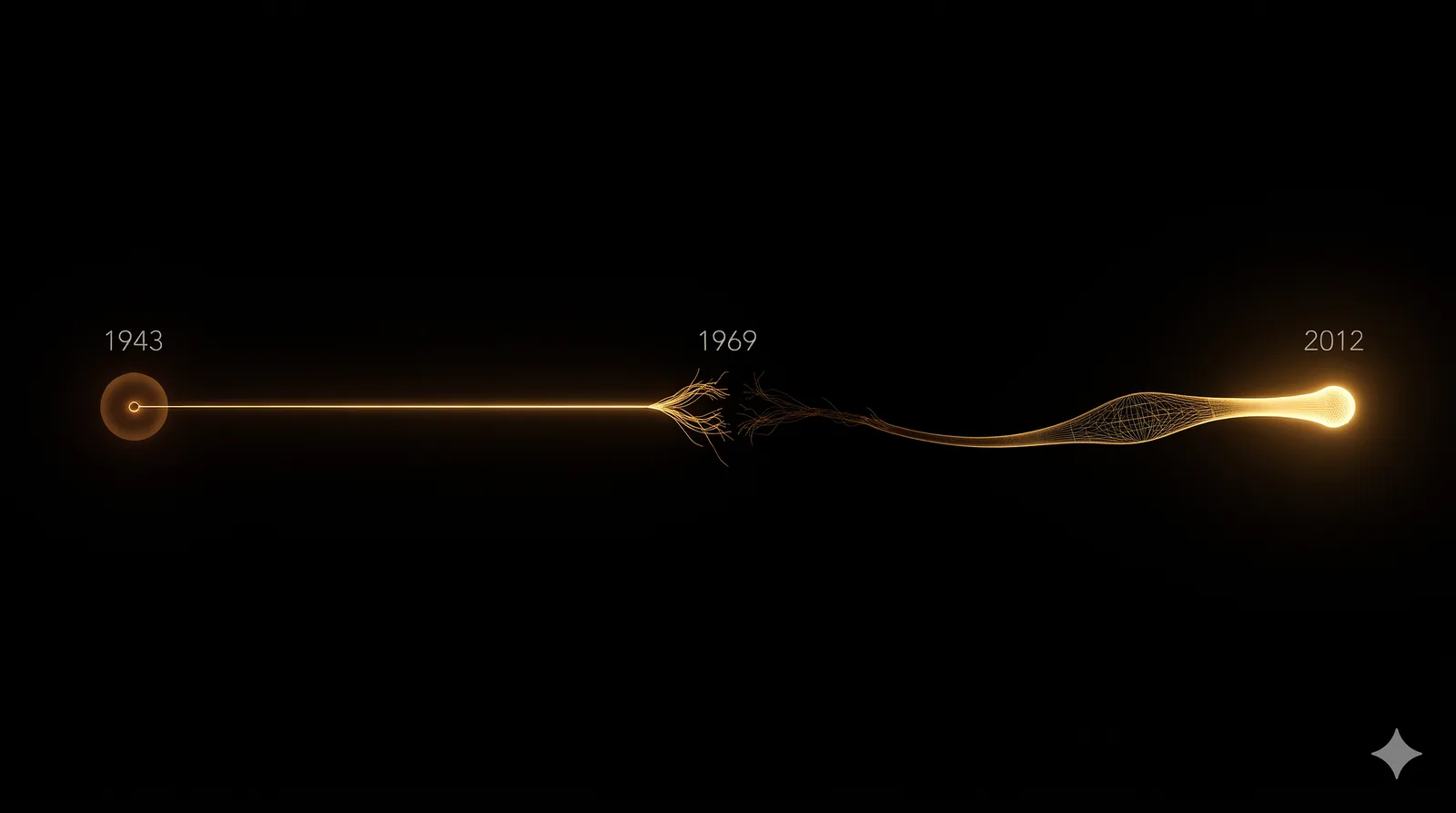
In the summer of 1943, a homeless nineteen-year-old was living in a professor’s house on the outskirts of Chicago.
His name was Walter Pitts. He had grown up in Detroit, the son of a boilermaker who settled arguments with his fists. By the time Pitts was twelve, he had spent three days in a public library reading Bertrand Russell’s Principia Mathematica, not because anyone told him to, but because he had found it on a shelf and could not stop.
He wrote Russell a letter pointing out errors in the work. Russell wrote back and told him to come to Cambridge. Pitts was twelve. He had no money and no way to get there, so he stayed in Detroit.
He ran away from home at fifteen. He educated himself in libraries. He drifted to Chicago, where by some chain of coincidences he met a forty-five-year-old neurologist named Warren McCulloch who was trying to solve a problem that had been irritating him for over a decade.
McCulloch wanted to know what a thought was made of, mathematically rather than philosophically. He believed the brain was a computing device at its core: a neuron either fired or it didn’t, and somewhere underneath consciousness there was a logical structure precise enough to describe.
He had been trying to find that structure for years. He had the neuroscience background but not the mathematics. Pitts, who had no formal education beyond the eighth grade, had the mathematics.
They worked in McCulloch’s house in the evenings. McCulloch’s wife brought them coffee. By 1943, they had a paper.
“A Logical Calculus of the Ideas Immanent in Nervous Activity” was published in the Bulletin of Mathematical Biophysics in December 1943. It was seven pages long.
It introduced the concept of an artificial neuron: a mathematical unit that takes inputs, applies a threshold, and either fires or doesn’t. McCulloch and Pitts showed that networks of these units could, in theory, compute any logical function.
They had not built a brain. They had done something stranger and more lasting: they had proved that a brain could be built. That the distinction between thought and mechanism was not categorical. That a machine, in principle, could think.
Almost no one read it. Walter Pitts, at nineteen, had just written one of the founding documents of artificial intelligence, neuroscience, and computer science simultaneously. He remained homeless.
Act I: The Optimist’s Machine
Fourteen years passed.
In 1957, a young psychologist named Frank Rosenblatt was working at the Cornell Aeronautical Laboratory in Buffalo, New York, a facility that had been built to study aircraft dynamics and found itself, in the postwar decade, being drawn toward stranger questions. Rosenblatt was not a mathematician. He was not a computer scientist.
He was a psychologist who believed, with an intensity that made some colleagues uncomfortable, that the gap between brain and machine was smaller than everyone assumed.
He had read McCulloch and Pitts. He had read about Hebb’s rule, the neuroscience finding that neurons that fire together wire together. And then he asked the question that would occupy the next decade of his life.
What if you could take a McCulloch-Pitts network and make it learn?
Rather than programming it with explicit rules, he wanted it to figure out the rules from examples, the way a child learns what a cat is not by reading a definition but by seeing enough cats.
Rosenblatt built the machine first in software, running on an IBM 704 at Cornell in 1957. What he had was 400 photocells arranged in a 20x20 grid as the input layer, a randomised set of connections, and a learning rule: when the machine guessed right, strengthen those connections. When it guessed wrong, weaken them. Run enough examples. Let it converge.
He called it the Perceptron.
On July 7, 1958, Rosenblatt demonstrated it to the press in Washington, D.C., at an event sponsored by the U.S. Office of Naval Research. He was careful in what he claimed. His published papers were technically precise, their scope deliberately limited. What he believed privately was larger, but he knew the difference between a proof and a vision.
Journalists do not always make that distinction.
The New York Times ran a headline the following day that said the Navy had shown the embryo of an electronic computer that it expects will be able to walk, talk, see, write, reproduce itself and be conscious of its existence.
Rosenblatt spent years after that demonstration trying to restore proportion to what people thought he had built. He wrote careful technical papers. He gave lectures that opened with caveats. It was largely futile.
By 1961, the Office of Naval Research had awarded his team $153,000, substantial funding for the period. Mark I, the hardware Perceptron, was built in Buffalo: a room-sized machine that could actually learn to distinguish simple patterns. Visitors came from across the country to see it.
Rosenblatt was thirty years old. He had started something important.
What he had actually started was a war.
Act II: The Kill Shot
Marvin Minsky did not lack for confidence.
By 1969, he was one of the most celebrated figures in artificial intelligence, having co-founded MIT’s AI laboratory and built the kind of institutional position that comes with the best funding, the best students, and the most prominent platforms in the field.
He had also, for some time, been deeply skeptical of neural networks, not the modest, collegial skepticism of a scientist with an alternative hypothesis, but the harder kind, the kind that shapes what a field decides to take seriously.
In 1969, Minsky and his collaborator Seymour Papert published Perceptrons: An Introduction to Computational Geometry. It was a rigorous book. The mathematics was real. And the central result was devastating: a single-layer perceptron cannot learn the XOR function.
XOR is a simple logical operation: given two inputs, return true if exactly one of them is true. Think of a room with two light switches where the light is on only when the switches disagree. It is not an exotic problem; it appears constantly in real computation. And the Perceptron, as Rosenblatt had described it, could not solve it.
This was true. Mathematically, unambiguously true.
What happened next was not mathematical.
A field read the book and drew a broader conclusion than the mathematics supported. DARPA cut funding. Research programs were shuttered. Journals stopped publishing neural network papers.
Young researchers who had staked their early careers on the idea were told, quietly and not so quietly, to find a different problem. This one was settled, and not in their favour. All of this came to be called the first AI Winter, and it lasted, in its worst form, for roughly fifteen years.
What Minsky and Papert had actually proved was narrower than what the field heard. Their XOR result applied to single-layer perceptrons. They had suggested it was unlikely that multi-layer networks would solve the problem, but they had not proved it. That distinction mattered enormously. And the field did not make it.
Years later, Minsky himself acknowledged that the critique had been misread. By then it was too late for some of the people it had affected.
Frank Rosenblatt died on July 11, 1971. It was his forty-third birthday. A boating accident in the Chesapeake Bay. He did not live to see what happened to his machine.
Walter Pitts had died two years earlier, on May 14, 1969, the same year Perceptrons was published. He was forty-six. He died of complications from cirrhosis. In the decade before his death, he had burned his research notes and largely stopped working.
The chain of events that undid him was complicated, as these things always are, but it began with a falling-out in 1952 between his mentor McCulloch and the mathematician Norbert Wiener, whose wife had accused McCulloch of something that was apparently untrue. Wiener cut off everyone connected to McCulloch, including Pitts. Pitts never recovered.
He died the year the work he had started was declared dead.
Act III: The People in the Basement
Geoffrey Hinton arrived at the problem the way certain people arrive at an obsession: early, completely, and in the face of considerable advice to do otherwise.
He had been interested in how the brain learns since his undergraduate years at Cambridge in the late 1960s, which happened to coincide almost exactly with the publication of Perceptrons and the beginning of the first AI Winter. His timing, in other words, was poor. The field he wanted to enter had just been told it was a dead end.
Hinton entered it anyway.
Over the following decade, as the consensus hardened against neural networks, he continued working on them. At conferences, results he presented were met with polite indifference or open skepticism. Senior figures in AI told him, in various ways, that the mathematics had settled the question and the interesting work was elsewhere.
He kept working anyway, convinced that the concept was correct and the technique was the problem. If someone could figure out how to train networks with more than one layer, the XOR limitation would become irrelevant and something much larger would emerge.
By the mid-1980s, he was at Carnegie Mellon, collaborating with David Rumelhart and Ronald Williams. They were working on a question that had been circling the field for years: how do you train a multi-layer network? How do you tell the layers deeper in the network - the ones not directly connected to the output- what they did wrong?
Backpropagation was their answer, though the idea itself was not entirely new; versions of it had appeared before. What Rumelhart, Hinton, and Williams did in 1986 was demonstrate it comprehensively and show that it worked on real problems.
Their paper, “Learning representations by back-propagating errors,” appeared in Nature on October 9, 1986, in Volume 323, issue 6088, pages 533 to 536. It had been received in May and accepted by July.
Four pages.
At its core, the intuition is not complicated, though the mathematics is. When a network makes an error, you calculate how much each connection contributed to that error, working backwards from the output layer toward the input. Then you adjust each connection in proportion to its contribution. Run enough examples. Let it converge.
This is precisely what the Perceptron had done, but only for a single layer. Backpropagation extended the same principle to networks of arbitrary depth. The XOR problem, the result that had shut down the field, dissolved entirely once you had two layers to work with.
Enthusiasm did not arrive immediately. A second, milder winter settled in during the late 1980s and early 1990s, when neural networks again failed to deliver on their implied promise. Funding dried up again, though not as completely as before. People working on neural networks continued working on neural networks.
Yann LeCun, working from Hinton’s ideas, demonstrated convolutional neural networks for recognising handwritten digits in 1989. US banks deployed the technology to read cheques. It was real, practical, used every day — and the field continued not to care very much.
Hinton moved to Toronto. It was quieter there. He had work to do.
The Reckoning
In September 2012, a team of three researchers from the University of Toronto submitted an entry to the ImageNet Large Scale Visual Recognition Challenge. The team was called SuperVision. Its members were Alex Krizhevsky, a PhD student; Ilya Sutskever, a former student of Hinton’s; and Geoffrey Hinton himself, then sixty-four years old.
ImageNet was an annual competition to build a system that could correctly classify photographs into one of a thousand categories.
At the time of the 2012 competition, the best systems were achieving a top-5 error rate- that is, the fraction of images for which the correct category was not in the system’s five best guesses, of around 26 percent. This had been the state of the art for some time, improving slowly.
SuperVision’s system achieved a top-5 error rate of 15.3 percent.
That gap was roughly eleven percentage points in a field where progress was measured in tenths. It was not a marginal improvement. It was a rupture.
The winning entry, which came to be called AlexNet, was a deep convolutional neural network with eight layers, 60 million parameters, and 650,000 neurons, trained on two commercial graphics processing units. It had taken weeks to train. It ran inference in seconds.
At NeurIPS in December 2012, the result was presented to a room of researchers who had spent careers measuring progress in fractions of a percentage point. An eleven-point gap did not need explaining. Word spread through the conference the way it spreads when a result cannot be explained away.
Within weeks, the result was circulating far beyond the conference. Within months, every major AI lab had a team working on deep learning. What had been an obscure competition entry became, in the following years, the starting pistol for the modern AI era.
Every major technology company reoriented around deep learning within two years. Google acquired the company Hinton had co-founded to commercialise the technology for $44 million in 2013.
The researchers who had been working in obscurity for decades became suddenly, startlingly valuable. The techniques that had been dismissed as theoretically limited and practically irrelevant turned out to be the foundation on which the next decade of technology would be built.
What Seventy Years Buys You?
Seventy years is a long time, and the temptation is to read the whole arc as a story of perseverance: the lone genius who kept working while everyone else gave up. But that is not quite what happened.
McCulloch and Pitts were right in 1943, but had no way to train what they had described. Rosenblatt was right in 1957, but his machine had a real limitation.
Minsky and Papert were right about that limitation, but the community drew a broader conclusion than the mathematics supported. Hinton and his collaborators were right about backpropagation, but the hardware to make it useful at scale did not exist for another decade after their 1986 paper.
Each piece was correct. The timing was wrong.
What changed between 1986 and 2012 was not the mathematics. The 1986 paper was essentially correct all along. What changed was that commodity graphics cards, built to render video games, turned out to be extraordinarily well-suited to the matrix multiplications that neural networks require.
AlexNet ran on two NVIDIA GTX 580 cards that you could buy for a few hundred dollars each. The hardware that unlocked deep learning was not built for deep learning. It was built for Halo and World of Warcraft.
The machine that changed AI was powered by GPUs. The GPUs existed because teenagers wanted smooth frame rates in first-person shooters. The connection is not metaphorical. It is literal.
Anyone building AI systems in 2026 is working on a foundation laid by a homeless teenager in a Chicago living room in 1943, extended by a psychologist in Buffalo in 1957, partially dismantled by a Cambridge professor in 1969, and quietly rebuilt by a stubborn researcher in Toronto who had been told for two decades that he was working on a dead problem.
The techniques are different. The core insight - that intelligence can emerge from networks of simple connected units, learning from examples, adjusting based on error, is the same insight McCulloch and Pitts had, written down in seven pages in a journal almost no one read.
That idea was declared dead once. It recovered.
Frank Rosenblatt did not live to see his machine become the architecture of a trillion-dollar industry. Geoffrey Hinton, who spent forty years working on the unfashionable problem, is now a Nobel laureate.
Somewhere in the world right now, there is almost certainly a researcher working on something the field has already dismissed, in a lab with insufficient funding, presenting results to rooms that are mostly empty. Seventy years of this history suggests it is worth paying attention to who that person is.
As for Walter Pitts: he burned his notes, drank himself to death at forty-six, and was buried in obscurity. His ideas outlived him by decades, quietly doing their work in every neural network that has been trained since. He never knew what he had started.
That is also how this works.
The Long Thread publication i started , traces the deep patterns in technology history: the ideas that took decades to mature, the wrong turns that weren’t entirely wrong, the people who were right before the world was ready. This is the first piece in the series.
Check out for more and do share your feedback in the comments
Sources
Papers
- A Logical Calculus of the Ideas Immanent in Nervous Activity. Bulletin of Mathematical Biophysics, Vol. 5, pp. 115–133
- Learning representations by back-propagating errors. Nature, Vol. 323, №6088, pp. 533–536. DOI: 10.1038/323533a0
- ImageNet Classification with Deep Convolutional Neural Networks. Advances in Neural Information Processing Systems 25 (NeurIPS 2012)
Web
- The Perceptron: A Probabilistic Model for Information Storage and Organization in the Brain. Psychological Review, Vol. 65, №6, pp. 386–408
- Perceptrons: An Introduction to Computational Geometry. MIT Press. Archive overview
- The Man Who Tried to Redeem the World with Logic. Nautilus, Issue 21
- Walter Pitts
- A Sociological Study of the Official History of the Perceptrons Controversy. Social Studies of Science, Vol. 26, №3, pp. 611–659
- Remembering Frank Rosenblatt
- Frank Rosenblatt
- The Man Who Gave Us the Neural Network Revolution. MIT Technology Review
- AlexNet
- Geoffrey Hinton — Nobel Prize in Physics
- AI: The Tumultuous History of the Search for Artificial Intelligence. Basic Books
- AI Winter