No. 04
The Paper That Was Written Twice
How the man who invented the digital age hid his greatest idea inside a war secret, and what happened when the secret ran out
In the winter of 1942, a young mathematician from Michigan arrived at a thirteen-storey building on the corner of West Street and Bethune Street in Manhattan’s West Village. His name was Claude Shannon. He was twenty-six. He had a desk, a chalkboard, and a problem he could not tell anyone about.
He also had a second problem. This was one he was not supposed to be working on at all.
West Street
By 1942, Bell Telephone Laboratories had spent forty years making 463 West Street one of the most consequential addresses in American science. Shannon arrived into a building under pressure.
Four thousand six hundred employees had swelled to more than nine thousand in a matter of years, and the cafeteria ran at capacity from breakfast until late evening. Many of the new arrivals wore military uniforms.
Some of the laboratories had been converted for classified use. The building felt, to those who worked there, like a city inside a city. Outside was the war; inside was the machinery the war ran on.
Shannon had come from MIT. His master’s thesis, written when he was twenty-one, proved something so obvious in retrospect that it is almost embarrassing nobody had seen it before: the mathematics of logic and the mathematics of electrical switching were the same thing.
Howard Gardner later called it “possibly the most important master’s thesis of the century.” Shannon filed it and moved on. He was already thinking about something else.
At Bell Labs his official problem was Project X, known internally as SIGSALY. Its purpose was to let Franklin Roosevelt and Winston Churchill speak by telephone across the Atlantic without the Germans intercepting the call.
That required solving, with wartime urgency, the problem of how to scramble a human voice so completely that nothing of it survived without the key. Shannon was assigned to verify that the system was unbreakable. He found the work interesting. He also found it, in some essential way, not quite the problem he wanted to be working on.
By night, in his apartment six blocks east of the lab, he went to jazz clubs on Bleecker Street, played chess in Washington Square Park, and filled yellow legal pads with the question Bell Labs had not asked him to answer: what, exactly, is information? Not in the vague, intuitive sense. Mathematically.
Precisely. In a form that could be measured the way temperature can be measured, or voltage. Something that could be put on a diagram and reasoned about.
He had been asking this question, in one form or another, since Princeton.
The Cafeteria
Shannon had been at West Street for about a year when, in January 1943, a visitor arrived. His name was Alan Turing.
Turing had come across the Atlantic on the Queen Mary, zigzagging to avoid U-boats, on a classified mission from Bletchley Park. British intelligence had sent him to advise on Project X, to verify what Shannon was also verifying. He had been given strict instructions: share as little as possible about how Britain was breaking German codes.
Bell Labs’ security office initially refused to let him through the front door.
Getting Turing admitted took weeks. He had to appeal to the American general Rex Minckler, who had already rejected his initial application. Eventually it was approved, and once inside he stayed for two months.
He and Shannon met every day for tea in the building’s cafeteria, a low, bright, noisy room that bore no resemblance to the kind of place where the history of science is supposed to happen. They sat across a table from each other with two months of daily proximity and nothing to say about the subject that had brought either of them there.
They did not talk about cryptography. Shannon was explicit about this for the rest of his life. “We talked not at all about cryptography,” he said in his 1982 IEEE oral history interview. “I don’t think we exchanged word one about cryptography.” Each knew what the other was doing. Each knew the other knew. The prohibition was mutual and was observed exactly.
What they talked about instead was whether machines could think.
Turing pulled out a copy of his 1936 paper, “On Computable Numbers with an Application to the Entscheidungsproblem,” and showed it to Shannon. Shannon had been developing related ideas independently and was struck by the overlap.
They compared notes. Shannon proposed that you might feed an electronic brain “cultural things,” music and language, and see what it made of them. According to James Gleick’s account in The Information, drawing on Andrew Hodges’s biography of Turing, they competed in brashness; Turing at one point exclaimed “No!” at the possibility of machine thought and then, after a pause, reconsidered.
It bordered on impudence to speculate this way in 1943. The transistor had not been invented. The electronic computer existed only in theory. What Shannon and Turing shared was not a technology. It was a conviction about the nature of thought itself, pursued in a cafeteria by two men who could not discuss the work that had brought them to the same room.
Both had arrived at their deepest ideas through the same oblique route: assigned to one problem, they had solved a different one on the side. Neither could tell the other.
The Classified Document
Two years passed. The war ended. Shannon kept working.
On September 1, 1945, he filed a technical memorandum with Bell Telephone Laboratories. Its designation was MM-45–110–02.
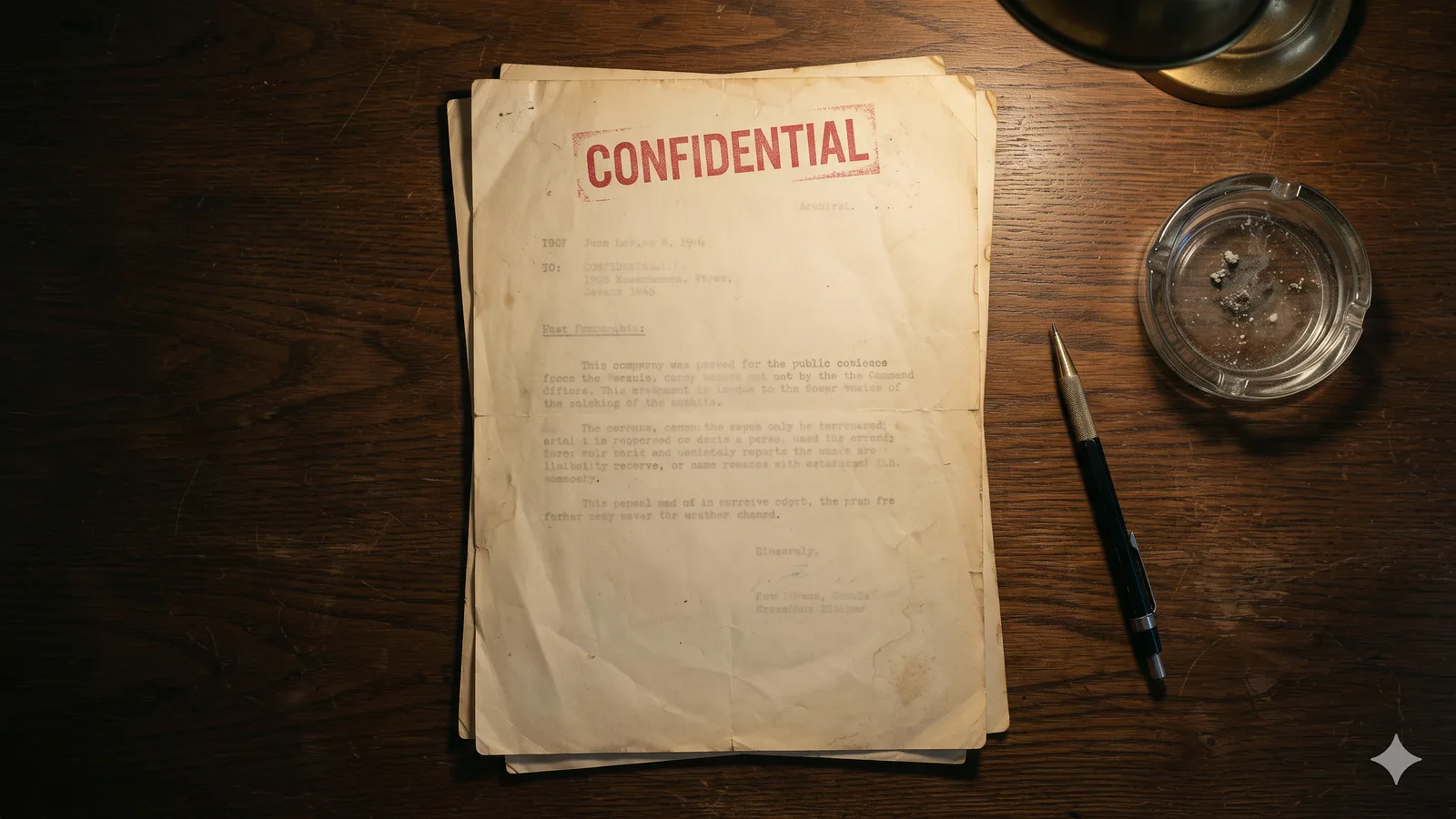
Its title was “A Mathematical Theory of Cryptography.” At the top of the cover sheet, in block letters, was a single word: CONFIDENTIAL.
At 114 pages, it was unlike anything that had existed in cryptography before. Shannon had proved it: the one-time pad was the only theoretically unbreakable cipher. Not argued, not conjectured. Proved.
A system in which the key is as long as the message, used exactly once, chosen at random. He had also built a framework for thinking about secrecy itself: how much information a cipher system conceals, how the redundancy of a language creates vulnerability in any code, what it means, precisely and mathematically, for a secret to be secure. He had not been asked to build this framework. He built it because the proof required it.
He had transformed cryptography from an art into a science. He had also, without quite intending to, written the first draft of information theory.
It was stamped with a declassification schedule: “Downgraded at 3-year intervals; declassified after 12 years.” The memorandum went into the Bell Labs classified files. It would sit there for four years.
Shannon moved on to the next problem.
The Paper He Almost Didn’t Submit
By 1944, Shannon had the mathematics of information theory essentially complete. He had been carrying the ideas for years: through Princeton, through the wartime cryptography work, in the margins of everything else he was assigned to do. What remained was not the work. What remained was the act of submitting it for publication, which Shannon found difficult to care about.
He was profoundly indifferent to recognition. He said so himself in his 1982 IEEE interview: he was drawn to problems for their own sake, rarely to what publishing them might bring. Left alone, he would have kept refining the manuscript indefinitely. His colleagues at Bell Labs knew what he had. They pushed him. He submitted reluctantly.
“A Mathematical Theory of Communication” appeared in two parts in the Bell System Technical Journal: July 1948 and October 1948. Shannon was thirty-two. The paper was fifty-five pages long. It began with a simple diagram: a sender, a channel, a receiver, a source of noise.
From this picture it built a complete mathematical theory of how information could be defined, measured, and reliably transmitted. It introduced the word “bit” as the fundamental unit of information.
Its central proof was the kind that, once you understand it, seems either obvious or impossible. Shannon showed that every noisy channel has a maximum rate of reliable transmission, a ceiling calculable in advance, and that this ceiling is always reachable if you are clever enough about how you encode the message.
It did not matter how much noise was in the channel. Reliable communication was always possible. This had not been believed. Shannon proved it and named it the channel capacity theorem and filed his notes away.
Engineers found it too mathematical. Mathematicians said it lacked rigour. One prominent mathematician reviewed it negatively. Shannon was not particularly bothered.
He had already moved on to building a robotic mouse named Theseus in his spare hours, a small electromechanical device that could work through a maze, remember where it had been, and find its way out.
He had also, without mentioning it in the 1948 paper, taken passages verbatim from the 1945 classified document. He acknowledged this plainly in his 1982 IEEE interview: “When I came out with my paper in ’48, part of that was taken verbatim from this secrecy thing, with this cryptography paper, which had not been published as yet.”
Nearly word for word in places, the public theory had been lifted from the secret one.
What Von Neumann Named?
Before submitting the 1948 paper, Shannon had a problem with terminology. He had developed a mathematical measure: a function that captured the uncertainty in a probability distribution, the average amount of surprise in a message from a given source. He needed a word for it.
He wanted to call it “uncertainty.”
John Von Neumann had a different suggestion. Shannon recounted the exchange for the rest of his life, and it appears in multiple sources. Von Neumann’s reasoning: “You should call it entropy, for two reasons. In the first place your uncertainty function has been used in statistical mechanics under that name, so it already has a name. In the second place, and more important, no one knows what entropy really is, so in a debate you will always have the advantage.”
Shannon called it entropy.
Entropy now lives in thermodynamics, statistical mechanics, and quantum information theory. It also lives, more consequentially for the present moment, inside the loss function used to train every large language model that exists. Cross-entropy loss is the standard by which a neural network measures how wrong it is and adjusts.
Every training run, every gradient descent step, every weight update in every AI system built in the last decade minimises a quantity whose name was chosen as a joke about winning arguments.
Shannon wanted to call it uncertainty. Von Neumann told him that no one knows what entropy really is.
He was right. The argument has never stopped.
The Pattern Becomes Visible
In October 1949, the Bell System Technical Journal published “Communication Theory of Secrecy Systems.” It was the declassified version of the 1945 memorandum, revised and expanded. Now both papers existed in the world, side by side, available to anyone.
And still the reversal was invisible.
Anyone encountering both papers in publication order would read them the same way: information theory first, cryptography application second. That Shannon had invented the general theory and then applied it. That the general theory had come first and the specific application second. That was not what had happened. The cryptography had come first.
The 1945 classified memorandum had come first. The 1948 information theory paper was, in substantial part, the declassified generalisation of a wartime secret. But almost no one had read the 1945 document before it was reclassified as ordinary, and those who knew it existed could not easily square the timeline.
Nobody stated it plainly, in published prose, until Whitfield Diffie wrote his preface to the formally released 1945 report in 2015. Diffie, co-inventor of public-key cryptography, wrote: “The order of presentation and the broad applicability of information theory to communication leave the impression that Shannon developed information theory first and then applied the new theory to cryptography. In fact, the situation is quite the reverse.”
By then Shannon had been dead for fourteen years.
Turing’s route had followed the same shape as Shannon’s. His universal computing machine had come from an attempt to solve the Entscheidungsproblem, a problem in mathematical logic so abstract it barely touched the physical world, and had ended up as the theoretical blueprint for every computer built since.
Shannon’s information theory had come from wartime cryptography, as applied a problem as engineering gets. Both men had solved the problem they were assigned and in doing so had produced something they were not assigned to produce at all. Neither had been able to tell the other.
Entropy House
Shannon spent his later years in a Victorian house in Winchester, Massachusetts, north of Boston. He called it Entropy House.
It reflected the man: full of gadgets, some of them working. Shannon had spent decades building things that amused him: a flame-throwing trumpet, a gasoline-powered pogo stick, a unicycle with an offset axle designed to defeat the rider’s instincts, various chess-playing machines of increasing sophistication. The juggling was constant.
He had studied it mathematically, worked out the equations governing the arc of balls in flight, and gotten good enough that at a conference in the 1980s he appeared unexpectedly, was recognised, was given three standing ovations, and juggled for the audience. He was, by any measure, the most important scientist in the room. He seemed mostly to find this amusing.
He had Alzheimer’s disease in his final years. He died on February 24, 2001, at the age of eighty-four.
By then, the field he had founded had produced the internet, mobile telecommunications, digital audio compression, error-correcting codes in every hard drive and compact disc ever made, and the mathematical foundations of modern AI.
His 1945 classified memorandum had been declassified for decades and was available to anyone who went looking. His 1948 paper, the one he almost didn’t submit, had become one of the most cited technical papers of the twentieth century.
At 463 West Street, the cafeteria where he and Turing had talked about thinking machines had been converted, long since, to residential apartments. Westbeth Artists Community now occupies the building. Painters and musicians live in the rooms where the digital age was invented.
Shannon had built his first communications system at the age of twelve: a telegraph line strung along the barbed-wire fences that ran between farms outside Gaylord, Michigan. Half a mile of wire connecting his house to a friend’s. It was crude and it worked.
He had already grasped, without having the words for it, the shape of the problem he would spend the rest of his life solving: how to send a message across a noisy medium and have it arrive intact.
He never stopped working on that problem. He just kept finding it everywhere he looked.
The declassified 1945 memorandum, “A Mathematical Theory of Cryptography,” is available through the Bell Labs technical archives. Whitfield Diffie’s 2015 preface is the clearest existing account of the relationship between Shannon’s cryptography work and information theory. Shannon’s 1982 IEEE oral history interview, conducted by Robert Price, contains his own account of the cafeteria meetings with Turing and of the relationship between the 1945 and 1948 papers.
Sources
Papers
- “A Mathematical Theory of Communication.” Bell System Technical Journal, Vol. 27, July and October 1948, pp. 379–423 and 623–656. https://doi.org/10.1002/j.1538-7305.1948.tb01338.x
- “A Mathematical Theory of Cryptography.” Bell Laboratories Technical Memorandum, MM-45–110–02, September 1, 1945. Classified CONFIDENTIAL; declassified. Full document: https://evervault.com/papers/shannon.pdf
- “Communication Theory of Secrecy Systems.” Bell System Technical Journal, Vol. 28, №4, October 1949, pp. 656–715. https://doi.org/10.1002/j.1538-7305.1949.tb00928.x
- Preface to “A Mathematical Theory of Cryptography” by Claude Shannon. December 2015. https://www.iacr.org/museum/shannon/wdiffie-preface.pdf
News
- “A Man in a Hurry: Claude Shannon’s New York Years.” IEEE Spectrum, March 2017. https://spectrum.ieee.org/amp/a-man-in-a-hurry-claude-shannons-new-york-years-2650275826
- Shannon’s account quoted in: Tribus, M. and McIrvine, E.C. “Energy and Information.” Scientific American, Vol. 225, №3, September 1971, pp. 179–188. And in: “Claude Shannon: Tinkerer, Prankster, and Father of Information Theory.” IEEE Spectrum, April 2016. https://spectrum.ieee.org/tech-history/cyberspace/claude-shannon-tinkerer-prankster-and-father-of-information-theory
Web
- The Information: A History, a Theory, a Flood. Pantheon Books, 2011. Chapter 7: “Information Theory.”
- A Mind at Play: How Claude Shannon Invented the Information Age. Simon & Schuster, 2017
- Alan Turing: The Enigma. Burnett Books, 1983. (Account of Turing’s time at Bell Labs, 1943.)
- Soni, Jimmy and Rob Goodman. A Mind at Play. Simon & Schuster, 2017. Chapters 1–3
- Wikipedia. https://en.wikipedia.org/wiki/Westbeth_Artists_Community
- Computer History Museum. “Claude Shannon’s Maze-Solving Mouse.” https://www.computerhistory.org/chess/stl-430b9bbd9b30d/