No. 09
Why Hindi Costs More in AI: The Story That Began in 1983
How a 1983 Kanpur terminal, a New Jersey placemat and a 1994 compression trick made AI read Hindi at a premium.
In 1983, a team at IIT Kanpur built a computer that worked in Devanagari in about eight months. The elegant code that followed made India’s scripts computable everywhere. Four decades later, that design is one of three reasons an AI conversation can cost more in Hindi than in English.
On 28 October 1983, the Third World Hindi Conference opened in New Delhi. A demonstration there came from IIT Kanpur: a terminal built in about eight months on an Intel 8086 processor for a Department of Electronics project. It did something most of the world’s computers could not. It worked in Devanagari.
Forty-three years later, the script that the terminal learned to write costs more to send through an AI. Spelled हिन्दी, the word Hindi takes 18 bytes in UTF-8, the encoding behind almost every web page; in English it takes five.
AI models read text in pieces called tokens, and Oxford researchers who compared the same text across languages found token counts differing by up to fifteen times.
Sarvam AI, a Bengaluru company, reported in 2023 that Hindi needed almost three to four times as many tokens as English in the GPT and Llama tokenisers of the time. Developers pay for every token. Users pay too, in slower replies and in less of their text fitting into what the model can hold at once.
Behind the terminal was Rai Mahesh Kumar Sinha, its chief investigator, a 38-year-old member of the Kanpur faculty who had spent a decade teaching computers to read and write the script.
His group, and the engineers who carried its work on, helped settle a question every Indian computer would need answered: what number does each letter get? What emerged was elegant. One code for each sound, shared by ten scripts, with every word spelled in the order it is spoken. Unicode later adopted its layout almost unchanged.
None of the decisions in this story was a mistake when it was made. The cost was assembled from three good decisions made decades and continents apart. One was made in Kanpur and New Delhi, one on a diner placemat in New Jersey, and one in a magazine article from Colorado Springs, later taken up in Edinburgh and San Francisco. None of their authors had the others in mind.
It began a decade before the conference, with a doctoral student trying to teach a computer to read.
Teaching Machines Devanagari
That student was Sinha, born in Gorakhpur on 25 October 1945. After degrees from Gorakhpur University, Allahabad University and IIT Kharagpur, he came for his doctorate to IIT Kanpur, which had been running an IBM 1620 since 1963.
His doctoral work, finished in 1973, tackled optical character recognition for Devanagari. IIT Kanpur’s own account calls him one of the first people to work on the problem.
Devanagari made the problem hard. An English page is built from 26 letters, each mostly standing alone. A Devanagari page combines consonants, vowel signs that sit above, below or beside them, and conjuncts, in which two or three consonants fuse into a single shape. A few dozen letters produce hundreds of visual forms.
To read them, Sinha’s work used a picture description language called PLANG, later published with H. N. Mahabala; I. K. Sethi and B. Chatterjee were attacking the same problem by 1976.
He joined the Kanpur faculty on 16 December 1975 and widened the question from reading to writing. At a symposium in Delhi in November 1978, his group and colleagues including A. Raman, A. K. Pathak and P. V. H. M. L. Narasimham presented work on a modular terminal for Indian languages and on phonetic keyboarding. Sinha’s own paper there examined Devanagari from what its title called an “information theoretic viewpoint.”
In 1983 the Department of Electronics sponsored a project to build the Integrated Devanagari Computer. By Sinha’s account, the team built it in about eight months, with multitasking firmware on the 8086.
That was the machine shown at the Hindi conference. The group then moved it to the Motorola 68000 processor and named the result GIST, for Graphics and Indian Script Terminal.
A terminal could now draw the letters. The country still had to agree on what number each letter would be.
One Code per Sound
That agreement came in stages, and the Bureau of Indian Standards later recorded them in its own history. In July 1983, the Department of Electronics announced a code called ISSCII-83.
It kept the American ASCII characters in the lower half of the table and placed Indian script characters in the upper 96 positions. In 1986, a keyboard standard followed, with a recommendation for an 8-bit ISCII code. In August 1988, the department revised the code to make it more compact, producing a version for the IBM PC.
Its principles mattered more than its dates. India’s major scripts share a Brahmi origin, so the same sounds sit in the same places in each alphabet. ISCII exploited that: a single character set and a single keyboard layout served all ten Brahmi-derived scripts.
Perso-Arabic scripts such as Urdu, Sindhi and Kashmiri needed a separate standard. A Tamil “ka” and a Hindi “ka” carried the same code; switching scripts changed how the letters looked, not what they were.
Within a word, characters were stored in the order they are pronounced. A conjunct was not given its own code. It was built by placing a halant, the sign that strips a consonant of its vowel, between two consonants.
The standard explained why. Composing conjuncts from basic characters meant every word had exactly one spelling, which spell checkers, dictionaries and search systems needed. That, the standard said, “would not have been possible” if conjuncts had separate codes.
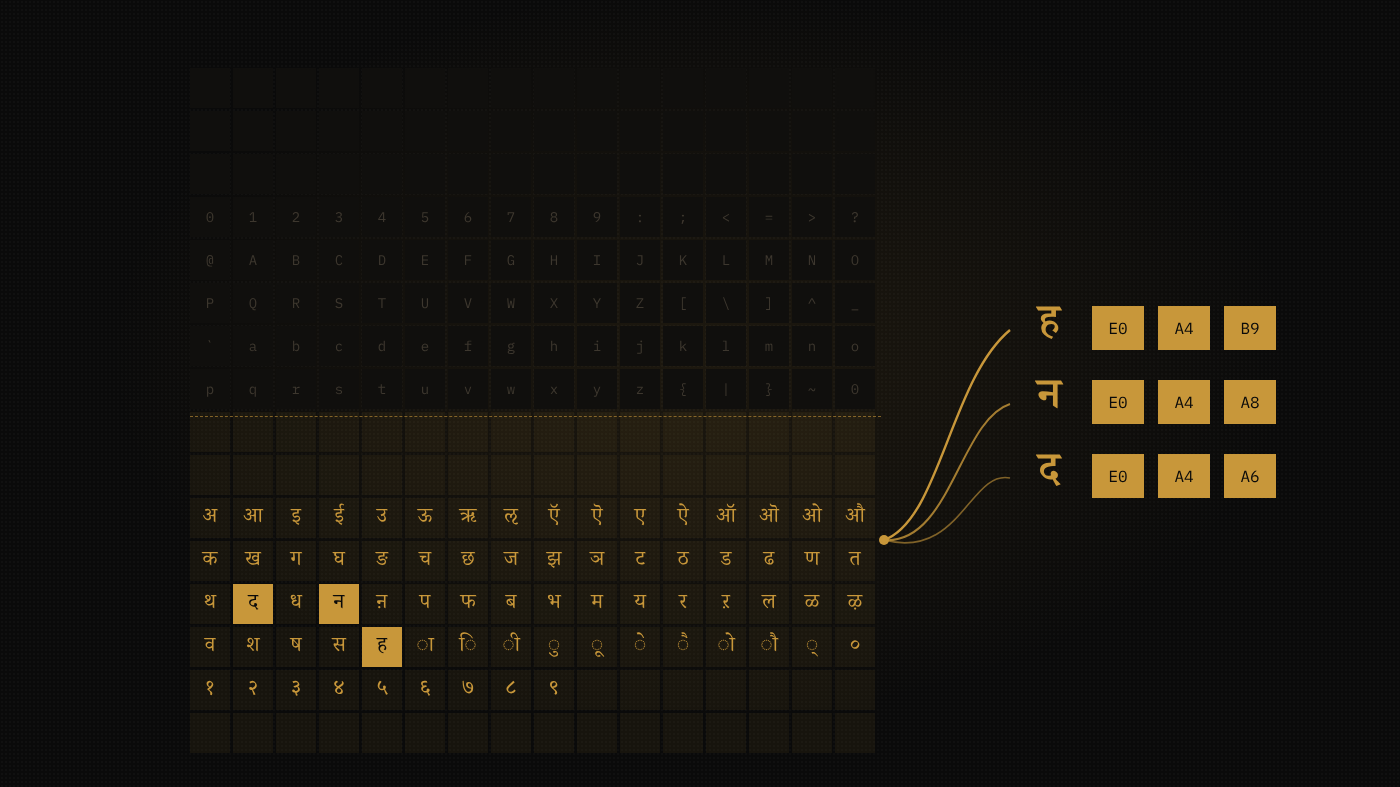
That choice had a price, and the price was length. Under ISCII’s rules, हिन्दी is stored as six codes: ह + ि + न + ् + द + ी. The fourth is the halant, which joins न and द into the conjunct न्द. A reader sees two syllables, hin and dee; the computer stores six codes. In 1988 the cost barely registered, because ISCII gave each code a single byte, the same as an English letter.
By then the work was moving to a new home. The Centre for Development of Advanced Computing, C-DAC, was set up in 1988 to build supercomputers; its own history cites the denial of American supercomputer imports. Almost at once it also began work on Indian-language computing.
Mohan Tambe, a research engineer at IIT Kanpur, joined C-DAC, and the GIST technology went with him. Tambe founded the GIST group there. He contributed to and authored the ISCII encoding and INSCRIPT keyboard standards, and developed the script composition algorithms for all ten scripts.
At C-DAC the acronym gained a new expansion: Graphics and Intelligence based Script Technology.
Credit is shared. IIT Kanpur names Sinha as the originator of ISCII coding and INSCRIPT keyboarding, and industry accounts credit Tambe with authoring the standards. Committees of the Departments of Electronics and Official Languages had worked on codes and keyboards since the 1970s. The Bureau of Indian Standards adopted the results as IS 13194 in 1991.
ISCII was built for Indian machines. That same year, its 1988 version was copied into a standard meant for every machine on earth.
The World Borrows the Layout
In October 1991, the Unicode Consortium published the first volume of the Unicode Standard. Its aim was a single numbering for every script, so a computer would no longer need to switch between national tables.
For India, it did not start from scratch. Unicode’s own specification states that its Devanagari block encodes characters in the same relative positions as ISCII-1988. Bengali, Gurmukhi, Gujarati, Oriya, Tamil, Telugu, Kannada and Malayalam followed the same layout.
Unicode’s main change was structural. Where ISCII used one table for all ten scripts, Unicode gave each script a block of its own, with no switching codes. The phonetic logic survived intact: the halant, the pronunciation order and the composed conjuncts all carried over.
In Kanpur, Sinha kept working on the problem, and in 1992 he wrote a report for UNESCO titled “Character Code Standardization.”
Unicode assigned numbers. Computers still had to turn those numbers into bytes, and storing every character in two bytes broke a great deal of software written for ASCII. The byte format then proposed alongside the ISO standard, called UTF, had problems of its own.
At Bell Labs, Ken Thompson and Rob Pike had used it in their Plan 9 operating system and, in Pike’s word, hated it. On a Wednesday evening in September 1992, usually dated to the 2nd, after a phone call from the standards group X/Open, they sat in the Corner Café in New Providence, New Jersey.
In Pike’s account, Thompson sketched the bit-packing for a new encoding on a paper placemat. It was so easy once they saw it, Pike wrote, that they left the placemat behind.
That encoding became UTF-8. Its central virtue was continuity: every ASCII character kept its single byte, so a plain ASCII string was also valid UTF-8. Characters further along in the Unicode table took more bytes. Anything from U+0800 to U+FFFF took three.
Devanagari sits at U+0900 to U+097F. In UTF-8, every Hindi letter, every vowel sign and every halant takes three bytes. The six codes of हिन्दी take 18 bytes, as against five for “Hindi.” In 8-bit ISCII, the word took six.
UTF-8 won. By August 2026, it was used by 99 percent of websites whose character encoding was known. For two decades, the extra bytes mattered little to most users, because disks grew and networks got faster. What changed their meaning was a compression trick, published less than two years after the diner, for a very different purpose.
A Compression Trick from Colorado Springs
In February 1994, The C Users Journal ran an article titled “A New Algorithm for Data Compression.” Its author, Philip Gage, was a software engineer in Colorado Springs with a degree in computer science from the University of Colorado.
His method, which he called Byte Pair Encoding, was simple. Find the pair of adjacent bytes that occurs most often, replace it everywhere with a byte not otherwise used, and repeat. He reported that it compressed almost as well as the popular LZW method, and that unpacking was much simpler and faster than packing.
For two decades, it remained one compression method among many. Then, in August 2015, three researchers at the University of Edinburgh, Rico Sennrich, Barry Haddow and Alexandra Birch, faced a problem in neural machine translation.
Their systems worked with a fixed vocabulary of whole words, so translating rare and unknown words was an open problem. Their solution, presented at ACL 2016 in Berlin, was to break words into smaller pieces.
They took Gage’s method and applied “a simple compression algorithm, to the task of word segmentation.” At Google, Mike Schuster and Kaisuke Nakajima had used a related idea, later known as WordPiece, for Japanese and Korean voice search in 2012.
Their version learned its pieces from training text. Pairs that appeared often were merged into single tokens; rare sequences stayed in fragments. Frequent words became one token each. Unfamiliar words were spelled out in several.
In 2019, OpenAI’s GPT-2 popularised a version that works directly on bytes. Its tokenizer started with the raw bytes of UTF-8 text and learned a vocabulary of 50,257 tokens. Any text in any script could now be represented, because every script was ultimately bytes. Many of the large models that followed adopted byte-level BPE or close relatives.
Here the three decisions met. The Hindi word arrived as a phonetic sequence of codes, a design from Kanpur and New Delhi. Each code arrived as three bytes, a design from New Jersey.
The tokenizer merged those bytes according to how often it had seen them, in training text dominated by English. Where it had seen a sequence often, it merged it. Where it had not, the bytes stayed apart, and each fragment was billed.
In 2023, Aleksandar Petrov and colleagues at Oxford measured the result on two thousand sentences translated into two hundred languages. The tokenizer behind ChatGPT and GPT-4 used about 1.6 times as many tokens for Italian as for English, and 2.6 times for Bulgarian.
Across the seventeen tokenizers they tested, some languages needed up to fifteen times as many. Because providers charge by the token, they wrote, the gap affected the cost of commercial services, response times and how much text fit into a model’s context.
Encoding is only part of the cause. Researchers building tokenizers for Indian languages point to another, which their own results suggest is larger: web-scraped data is skewed towards English, which leaves less material to train tokenizers on everything else. Three bytes per letter cost little once a tokenizer has learned to merge them.
The Thread
Laid end to end, the story turns on three decisions, each correct for its problem. ISCII gave every sound one code and every word one spelling, so that dictionaries, spell checkers and search systems would agree across ten scripts.
UTF-8 kept decades of ASCII software running by giving English letters the shortest codes; Thompson and Pike were solving an operating system’s problem, not designing a price list. Byte pair encoding was built to shrink files, then repurposed to translate rare words, and it learned from whatever text it was given.
None of the three was made with the others in mind. Together they produced a cost no one chose. In November 2026, a writer on the Asian technology site e27 described filing a consumer complaint against seven global AI companies. The article called the gap a “linguistic tax.”
Following its end, the thread also shows where costs can be cut. In 2024, Sarvam AI released Sarvam-1, a model with a tokenizer trained for ten Indian languages. The company reported that existing multilingual models often needed four to eight tokens per word in Indic scripts, against 1.4 for English.
Its own tokenizer needed between 1.4 and 2.1 across every supported language. A January 2026 study found that OpenAI’s newer tokenizer, the one used by GPT-4o, reduced the gap significantly compared with its predecessor, though it did not close it. The bytes had not changed. What changed was where the tokenizer learned its merges, and how many it kept.
The Professor at Kanpur
Sinha did not stop at scripts. From the late 1980s he led work on machine translation between English and Indian languages, under the names AnglaBharati and AnuBharati.
He became the founding president of the Society for Machine Aids for Translation and Communication and served on the government’s language technology committees. He later chaired a working group on localisation and language technology standards for the National e-Governance Plan.
He died in 2016. A colleague’s tribute on the institute’s memorial page remembered him as “a very gentle soul.”
He spent much of his career on two problems: how a machine should represent Indian letters, and how it should translate between Indian languages and English. Large language models now do both, at a scale no 1983 terminal could have suggested.
In November 1978, aged 33, he presented a paper in Delhi that looked at Devanagari through information theory, the mathematics Claude Shannon published in 1948 for measuring how compactly a message can be coded.
Nearly half a century later, AI services price a Hindi sentence by a close cousin of that count. The letters they count are the ones his machine learned to write in 1983.
Sources
Papers
- Machine recognition of Devanagari script. IEEE Transactions on Systems, Man and Cybernetics, 1979, pp. 435–441; I. K. Sethi and B. Chatterjee, Machine recognition of handprinted Devanagari numerals, J. IETE 22, 1976; Machine recognition of constrained hand printed Devanagari, Pattern Recognition 9, 1977
- A Journey from Indian Scripts Processing to Indian Language Processing. IEEE Annals of the History of Computing, 31(1), 8–31, 2009
- Third World Hindi Conference, New Delhi, 28–30 October 1983; Lok Sabha, 17 November 1983
- IS 13194:1991, Indian Script Code for Information Interchange (ISCII)
- A New Algorithm for Data Compression. The C Users Journal, February 1994
- Japanese and Korean voice search. ICASSP 2012
- Language Model Tokenizers Introduce Unfairness Between Languages. NeurIPS 2023
- The Art of Breaking Words: Rethinking Multilingual Tokenizer Design, 2025; Is Sanskrit the Most Token-Efficient Language?, January 2026; BHARATI: Morphology-Aware Tokenizers for Classical Indian Languages, 2026
Web
- Dr. Rai Mahesh Kumar Sinha (1945–2016), obituary and memorial page
- Research and projects, IIT Kanpur (includes the 1978 symposium papers, the Integrated Devanagari Computer project report, 1984, and the UNESCO report, 1992)
- The IBM 1620 at IIT Kanpur, 1963
- About C-DAC and GIST
- Reverie Language Technologies honours 50 years of Indian-language computing
- GIST and the multilingual revolution, 30 April 2012
- The Unicode Standard, Chapter 12: South and Central Asia I; Unicode 1.0.0, October 1991; Indic FAQ
- UTF-8 history, 30 April 2003; UTF-8 turned 20 years old, 2012. Markus Kuhn dates the design to 2 September 1992 (IETF charsets list, 2003)
- RFC 3629: UTF-8, a transformation format of ISO 10646, IETF, November 2003
- Usage statistics of character encodings for websites, 31 August 2026
- Neural Machine Translation of Rare Words with Subword Units. ACL 2016 (arXiv, August 2015)
- Language Models are Unsupervised Multitask Learners (GPT-2), OpenAI, 2019; model card noting byte-level BPE
- OpenHathi series, 12 December 2023; Sarvam-1: the first Indian language LLM, 2024
- Why I filed a consumer complaint against 7 global AI giants over the “linguistic tax”, November 2026
Cite this story
- APA
- Chandrayan, P. (2026, November 26). Why Hindi Costs More in AI: The Story That Began in 1983. The Long Thread. https://thelongthread.in/stories/why-hindi-costs-more-in-ai-the-story-that-began-in-1983
- MLA
- Chandrayan, Pramod. “Why Hindi Costs More in AI: The Story That Began in 1983.” The Long Thread, 26 Nov. 2026, thelongthread.in/stories/why-hindi-costs-more-in-ai-the-story-that-began-in-1983.
- Chicago
- Chandrayan, Pramod. “Why Hindi Costs More in AI: The Story That Began in 1983.” The Long Thread, November 26, 2026. https://thelongthread.in/stories/why-hindi-costs-more-in-ai-the-story-that-began-in-1983.