No. 10Right Too EarlyLong Argument
The Move No Human Would Play
In 1997 a machine’s strange move shook the world chess champion. It was a bug. Nineteen years later a machine’s strange move in Go was genius. What changed in between is the story of modern AI.
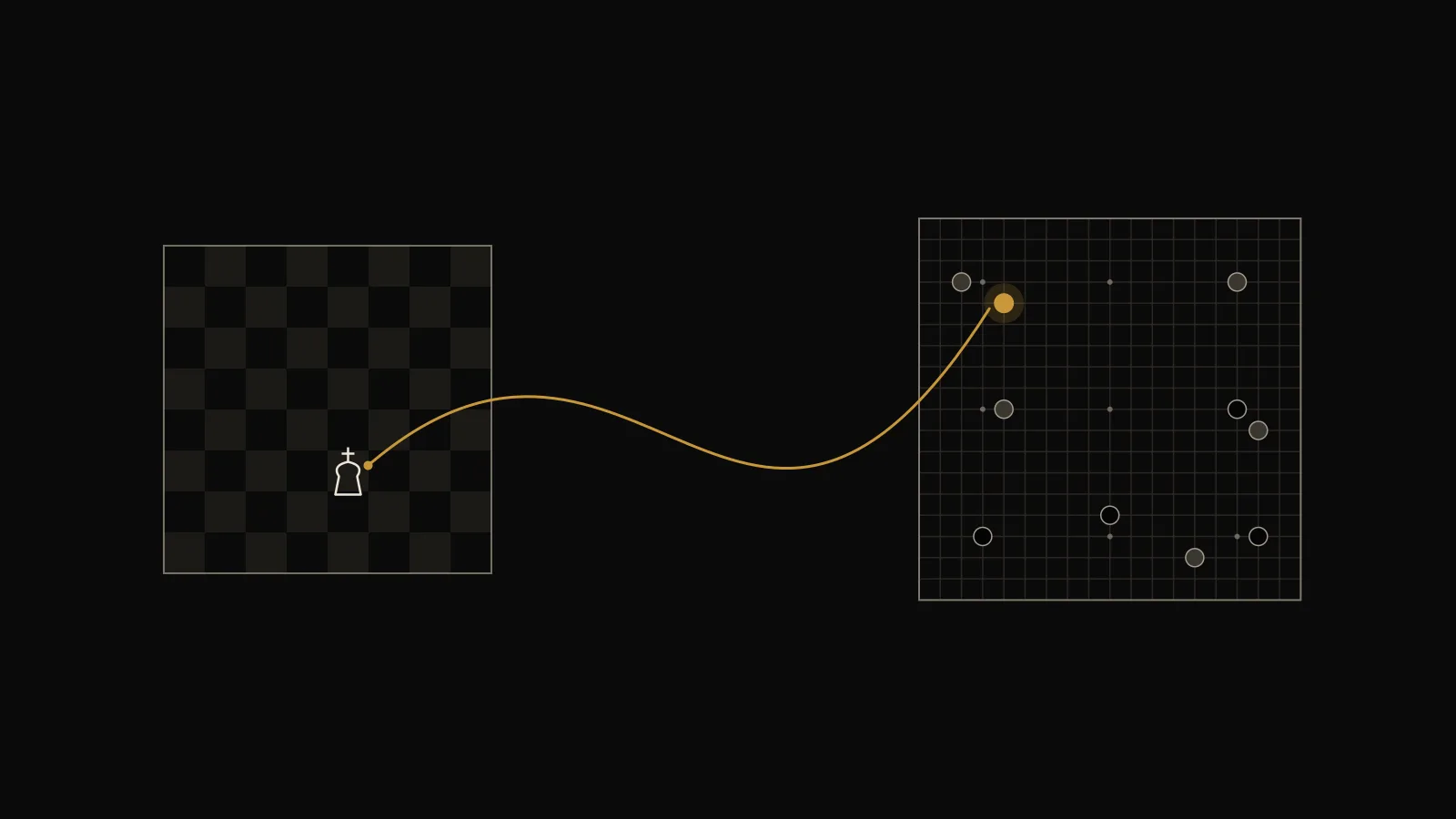
A boy in London reached chess master strength at thirteen. In 2016, the machine he had helped build beat the South Korean Go master Lee Sedol, and in 2024 he shared the Nobel Prize in Chemistry. Between those moments lies the story of how computers stopped following rules and started learning, and it began with a machine that only looked clever by accident.
In the first week of May 1997, the best chess player in the world sat down for a six-game rematch against a computer and won the first game. Garry Kasparov should have left that game confident. Instead, one move kept bothering him.
Late in the game, at move 44, the IBM machine called Deep Blue played something that made no obvious sense. In chess, every strong move has a reason: it attacks, it defends, or it prepares something. This one did none of those that Kasparov could see. To a champion who had spent his life reading the intentions behind moves, a move without a visible purpose meant only one thing: a purpose he could not see. His team, it was later said, stayed up that night trying to work out the logic behind it.
Deep Blue won game two. Shaken, Kasparov resigned it in a position that analysts later judged he might have saved.[1] He did not win another game in the match.
Years later, one of Deep Blue’s engineers, Murray Campbell, gave a simpler explanation, first to the statistician Nate Silver and then on the radio. The machine had been calculating a move that would drag the game out, he said, “and then at the last second, it switched to a completely different move and played it.” There was no logic to find. “Due to a bug in the program, unfortunately, it had played a random move.”[2] Campbell’s theory is that Kasparov came away overestimating the machine. Kasparov rejects it: through his long-time aide Mig Greengard, he called the idea that the move affected his play “ridiculous.”
Whatever was in his head, the record is plain. On 11 May 1997, Deep Blue won the sixth game and the match, three and a half points to two and a half.[3] For the first time, a reigning world chess champion had lost a match to a machine.
Nineteen years later, in Seoul, another machine played a move that no human expert would have chosen. This time the experts were right to be afraid of it. What changed between those two moves is the story of how computers learned to play, and then learned to learn.
Act I: The Blueprint
Chess grew from chaturanga, a game first recorded in north India around the sixth century, which spread west through Persia[4]. By the twentieth century it had become the world’s favourite test of a sharp mind. The idea that a machine might play it is older than the machines. In March 1950, Claude Shannon, the Bell Labs mathematician who had founded information theory two years earlier[5], published “Programming a Computer for Playing Chess” in the Philosophical Magazine.[6] It was the first serious paper on the subject.
Shannon explained his choice in the paper. Chess was sharply defined, in its moves and in its goal. It was neither so simple as to be trivial nor too hard to make progress on. And it was generally agreed to require “thinking” for skilful play.[7] If a machine could do it, the argument went, the question of whether machines could think would have to be taken seriously.
His paper set out the problem that would shape the next half-century. A computer could, in principle, look at every legal move, then every reply, then every reply to the reply, like a tree branching and branching again, and pick the branch that led to the best position. Programmers call this searching. The trouble was the number of lines. They multiply so fast that no machine could ever explore them all. A program would have to search some lines deeply and ignore most of the rest, and the art would lie in choosing which.
In Britain, Alan Turing had been working on the same question. With his colleague David Champernowne he had written a chess program in 1948, before there was a computer able to run it. In the summer of 1952, Turing played it anyway. He acted as the computer himself, working through the program’s rules by hand with pencil and paper, sometimes taking half an hour to choose a single move, against his colleague Alick Glennie.[8]
The program lost in 29 moves. But the principle had been demonstrated. A set of written rules, followed mechanically, could play a legal and not entirely foolish game of chess. Everything that followed was a question of speed and of judgment.
Act II: The Soviet Champion
It is easy to tell this as an American story. It was not, from the start.
In 1974, the first World Computer Chess Championship was held in Stockholm. The winner was a program from Moscow called Kaissa, named after Caissa, the goddess of chess. It had been built at the Institute of Control Sciences by a team including Vladimir Arlazarov, Alexander Uskov and Mikhail Donskoy, and it ran on a British-made ICL computer compatible with IBM’s machines.[9]
Kaissa won all four of its games.[10] The first world title for machines went to Moscow.
Kaissa followed the path Shannon had laid out: look ahead a fixed number of moves, judge the positions it reached, and choose the best. For the next two decades, that was how strong chess programs worked. They did not understand the game the way a grandmaster did. They searched it, faster and deeper every year, as computers grew more powerful.
In other words, from the very first world title, machines won by searching, not by understanding. The question was whether searching would ever be enough to beat the best human alive.
Act III: Brute Force Wins
By the 1990s, IBM had a machine built for one purpose. Deep Blue combined general-purpose computers with custom chips designed only to evaluate chess positions, and it searched far more of them each second than any program before it.[11] The chips were designed by Feng-hsiung Hsu. The final versions arrived three weeks before the 1996 match and, Campbell later admitted, were never fully debugged: “There were programming errors that caused crashes during that first match.”[12]
In February 1996, in Philadelphia, it played Kasparov over six games. Deep Blue won the first. It was the first time a computer had beaten a reigning world champion in a game played under normal tournament conditions. Kasparov then won three games and drew two, taking the match four points to two.[13] Human judgment, it seemed, still had the edge.
The rematch fifteen months later was different. After the bug-driven move of game one and the loss of game two, Kasparov made an accusation that would follow the match for years. He suggested that the IBM team had received help from a human grandmaster during play, pointing to a move in game two, the 36th, that he believed no computer of the time would have chosen. IBM denied it.[14]
Three draws followed. Then, on 11 May, Kasparov lost the sixth game, and with it the match.
“I was in shock, exhausted, and bitter about everything that had happened on and off the board,”[15] Kasparov later wrote of the press conference that followed. He asked for another rematch. IBM declined and retired the machine. Deep Blue never played again.
That year, a young Cambridge student who had once been the second-highest-rated chess player in the world for his age was playing in the university’s varsity matches against Oxford, as he had for three years. His name was Demis Hassabis. He had started playing at four, reached master strength at thirteen, and finished just behind the Hungarian prodigy Judit Polgár in the rankings for under-fourteens.[16] “I learned when I was four years old,” he has said of the game. By his teens, “I was more or less a professional chess player.”[17] Nineteen years later, he would be on the other side of the board.
It was a historic result built on an old method. Deep Blue did not learn chess. Its strength came from searching enormous numbers of positions and from rules that people had written to judge them. Engineers call this brute force: winning by checking more possibilities than any person could, not by knowing more. It proved that, for chess, brute force guided by human knowledge was enough to beat the best human.
It also seemed to prove the limits of that approach. There was another game, older than chess, where searching harder was hopeless.
Act IV: The Game That Resisted
Go is played on a grid of nineteen lines by nineteen, with black and white stones placed one at a time. If chess is a battle to capture a king, Go is a contest to surround territory. The rules fit on a page. The game has been played in China, Korea and Japan for centuries, and it is far larger than chess in the only sense that mattered to a computer: there are vastly more possible positions, and far more sensible moves at each turn.
That broke Shannon’s method. A program could not look ahead far enough to see the consequences of a move, and nobody could write good rules for judging who was ahead. Strong human players often describe their judgment in terms of shape and feel rather than calculation. For years after Deep Blue, the best Go programs remained well short of top professionals.
The answer came from neural networks, an idea first sketched in 1943[18]: programs loosely modelled on the brain’s web of neurons, which are not told how to judge a position but learn to, from examples. In London, a company called DeepMind, co-founded by Hassabis and bought by Google in 2014[19], combined them with search. One network learned to suggest promising moves. Another learned to estimate who was winning. The program, AlphaGo, studied a large collection of human games and then improved by playing millions of games against versions of itself.[20]
The result was kept secret until 27 January 2016, when DeepMind published it in Nature in a paper titled “Mastering the game of Go with deep neural networks and tree search.” By then a much bigger match had been arranged, against one of the strongest players of his generation.
Act V: Move 37 and Move 78
In March 2016, in Seoul, AlphaGo played Lee Sedol of South Korea over five games. Google’s own announcement called him “the legendary Lee Sedol.”[22]
AlphaGo won the first game. In the second, at move 37, it placed a stone that DeepMind’s team later described as a move a human player would almost never choose. As the game went on, its purpose became clear: it was the turning point of the game.
This was the reverse of Deep Blue’s move 44. In 1997, a move that looked deep was an accident. In 2016, a move that looked like a mistake was the product of a system that had found something its human teachers had missed.
AlphaGo won the third game too, and with it the match. Then, on 13 March, in game four, Lee found a move of his own. At move 78 he placed a stone that split the machine’s position in the centre of the board. AlphaGo answered badly. Hassabis later said the program had made its mistake at move 79 but believed it was still doing well, and did not recognise the error until move 87.[23] Lee won. “This victory is priceless,” he said afterwards, smiling. “I wouldn’t trade it for the world.”[24]
It was the only game a human would win against AlphaGo in a formal match. The program took the fifth game and the series, four games to one.
In November 2019, Lee Sedol retired from professional Go. Reports at the time quoted him describing AI as an opponent that could not be defeated. His own explanation was quieter: he could no longer enjoy the game.[26]
Act VI: From Games to the Nobel
AlphaGo had still learned from human games. Its successor did not.
In December 2017, DeepMind described AlphaZero, a program given nothing but the rules of chess, Go and shogi, a Japanese cousin of chess. It learned each game only by playing against itself. In chess, DeepMind reported, it was outperforming Stockfish, then one of the strongest conventional programs, after about four hours of this self-training.[27] The comparison with Deep Blue’s approach was stark: AlphaZero examined roughly sixty thousand chess positions a second, against tens of millions for Stockfish. It searched a thousand times less and played better, because it had learned which positions were worth examining.
Critics questioned the conditions of that first match, and the full results were published, peer-reviewed, in Science a year later.[28] But the direction was clear. The knowledge that Deep Blue’s engineers had written by hand could now be learned from nothing.
Then DeepMind turned the same kind of system away from games. Proteins, the molecules that do most of the work in living cells, fold into intricate shapes, and their shape determines what they do. Since the 1970s, researchers had tried to predict a protein’s shape from the sequence of its building blocks, and failed; the Nobel committee called it a 50-year-old problem. In 2020, Hassabis and John Jumper presented AlphaFold2, which went on to predict the structure of virtually all of the 200 million proteins researchers had identified.[29]
On 9 October 2024, the Nobel Prize in Chemistry was awarded half to David Baker, for computational protein design, and half jointly to Demis Hassabis and John Jumper of Google DeepMind, for protein structure prediction. By then, AlphaFold’s freely available predictions had been used by more than two million researchers in 190 countries.[29] In his Nobel lecture, Hassabis traced the line back to the board in Seoul.[30]
The Thread
Read from end to end, the thread runs from a question about thinking to a prize for chemistry, and it turns twice.
The first turn was brute force. Shannon’s blueprint, Kaissa’s title and Deep Blue’s victory all rested on the same idea: search more positions, faster, with human rules to judge them. It worked for chess. It did not tell anyone how thinking works, and the most unsettling move of 1997 turned out to be a bug.
The second turn was learning. Go could not be searched into submission, so machines were built to learn what to search. Move 37 was not an accident. It was a judgment no human had taught, and the lab that made it went on to win a Nobel Prize for a problem that had nothing to do with games.
Games were chosen, from Shannon onward, because they seemed to demand intelligence. Each time a machine mastered one, the definition of intelligence quietly moved: chess, people said, was only calculation; Go was only pattern recognition. DeepMind was founded in 2010 with a stated goal to “solve intelligence,”[31] and it made its name on a board. Whether learning to win games leads anywhere near general intelligence is still argued, as it has been since 1950.
The same shift, from rules written by people to judgment learned from data, is what powers today’s AI assistants. In October 2025, OpenAI’s chief executive, Sam Altman, told developers that more than 800 million people were using ChatGPT every week.[32] The argument has a new feature now. The machines have stopped making moves that only look clever by accident.
The Boy at the Board
When the 2024 chemistry prize was announced, the chess press noted that one of the three laureates had an illustrious past at the board.
Hassabis had learned the game at four. At thirteen he was a master, second in the world for his age. He got his first computer, a ZX Spectrum, at about eight, and one of the first programs he wrote played the board game Othello.[17] Games were where his interest in thinking machines began, just as Shannon, in 1950, had chosen chess as his test because it was sharply defined and generally agreed to require thinking.
In 1997, while he was still playing for Cambridge, a machine beat the world champion by searching harder than any human could. Nineteen years later, his own machine beat Lee Sedol by learning what no human had taught it.
The boy who wanted to know how minds work ended up building one that taught itself. He started where Shannon did, with a game.
Thread crossings
- This thread crosses The Paper That Was Written Twice in 1942, through Claude Shannon.
- This thread crosses The Scientists Who Taught Machines to Guess the Next Word in 1948, through Claude Shannon.
- This thread crosses The Compiler Nobody Wanted in 1952.
Conversation
No comments yet. Memories, sources and questions are all welcome. To write about one moment, open its knot on the thread and choose “Add a note”.
Sources
Suggest a correction or a source
Papers
- “A Mathematical Theory of Communication.” Bell System Technical Journal, Vol. 27, July and October 1948, pp. 379–423 and 623–656. https://doi.org/10.1002/j.1538-7305.1948.tb01338.x
- Hsu, “IBM’s Deep Blue chess grandmaster chips,” IEEE Micro, 1999. https://archive.computerhistory.org/projects/chess/related_materials/text/5-4.IBM's_deep_blue_chess_grandmaster_chips/5-4.IBM's_deep_blue_chess_grandmaster_chips.hsu-fh.1999.IEEE.062303055.sm.pdf
- Computer History Museum. https://archive.computerhistory.org/resources/text/Oral_History/Campbell_Murray/Campbell_Murray.oral_history.2005.102657914.pdf
- A Logical Calculus of the Ideas Immanent in Nervous Activity. Bulletin of Mathematical Biophysics, Vol. 5, pp. 115–133
- D. Silver et al., “Mastering the game of Go with deep neural networks and tree search,” Nature 529, 484–489, 27 January 2016. https://www.nature.com/articles/529445a
- Phys.org. https://phys.org/news/2016-03-human-champ-scores-victory-supercomputer.pdf
- Nobel Prize. https://nobelprize.org/uploads/2024/12/hassabis-lecture.pdf
News
Web
- Chessprogramming wiki. https://www.chessprogramming.org/Kasparov_versus_Deep_Blue_1997
- Deep Blue, NPR, 8 August 2014 (Murray Campbell; Mig Greengard). https://www.npr.org/transcripts/338850323
- Computer History Museum. https://www.computerhistory.org/chess/defeating-the-world-chess-champion/
- ChessBase. https://en.chessbase.com/post/on-the-origins-of-chess-part-2-india
- Claude E. Shannon, “Programming a Computer for Playing Chess,” Philosophical Magazine 41(314), March 1950, 256–275. https://ebiquity.umbc.edu/paper/html/id/1225/Programming-a-Computer-for-Playing-Chess
- Fermat’s Library. https://fermatslibrary.com/s/programming-a-computer-for-playing-chess
- History of Information. https://historyofinformation.com/detail.php?entryid=4364
- Computer History Museum. https://www.computerhistory.org/chess/stl-430b9bbd92710/
- ICGA. https://www.game-ai-forum.org/icga-tournaments/tournament.php?id=7
- Wikipedia. https://en.wikipedia.org/wiki/Deep_Blue_versus_Garry_Kasparov
- , quoted in “20 years ago, Deep Blue beat Garry Kasparov.” Forward. https://forward.com/culture/371657/20-years-ago-deep-blue-beat-garry-kasparov-and-changed-the-world/?amp=1
- ChessBase. https://en.chessbase.com/post/demis-hassabis-from-deep-mind-wins-nobel-in-chemistry
- Wikipedia. https://en.wikipedia.org/wiki/Google_DeepMind
- Wikipedia. https://en.wikipedia.org/wiki/AlphaGo_versus_Fan_Hui
- Google. https://blog.google/technology/ai/alphagos-ultimate-challenge/
- NPR. https://www.npr.org/sections/thetwo-way/2016/03/13/470284113/after-three-losses-master-go-player-scores-a-win-against-computer
- 1 Go player, May 2017. Phys.org. https://phys.org/news/2017-05-chinese-champion.amp
- Courthouse News. https://www.courthousenews.com/go-grandmaster-retires-says-computers-cannot-be-defeated/
- Google DeepMind. https://deepmind.google/research/breakthroughs/alphazero/
- Chess.com. https://www.chess.com/news/view/google-s-alphazero-destroys-stockfish-in-100-game-match
- Nobel Prize. https://www.nobelprize.org/prizes/chemistry/2024/press-release/
- Google DeepMind. https://deepmind.google/discover/blog/from-unlikely-start-up-to-major-scientific-organisation-entering-our-tenth-year-at-deepmind/
- Britannica. https://www.britannica.com/biography/Demis-Hassabis
Cite this story
- APA
- Chandrayan, P. (2026, November 27). The Move No Human Would Play. The Long Thread. https://thelongthread.in/stories/the-move-no-human-would-play
- MLA
- Chandrayan, Pramod. “The Move No Human Would Play.” The Long Thread, 27 Nov. 2026, thelongthread.in/stories/the-move-no-human-would-play.
- Chicago
- Chandrayan, Pramod. “The Move No Human Would Play.” The Long Thread, November 27, 2026. https://thelongthread.in/stories/the-move-no-human-would-play.