No. 11Right Too EarlyGiven AwayBuried Credit
The Idea a Reviewer Called Too Simple to Fund
In 1972, Nasir Ahmed’s proposal was turned down as “too simple.” Today, a version of his idea shrinks the JPEG photos, video calls and streams most of us use every day.
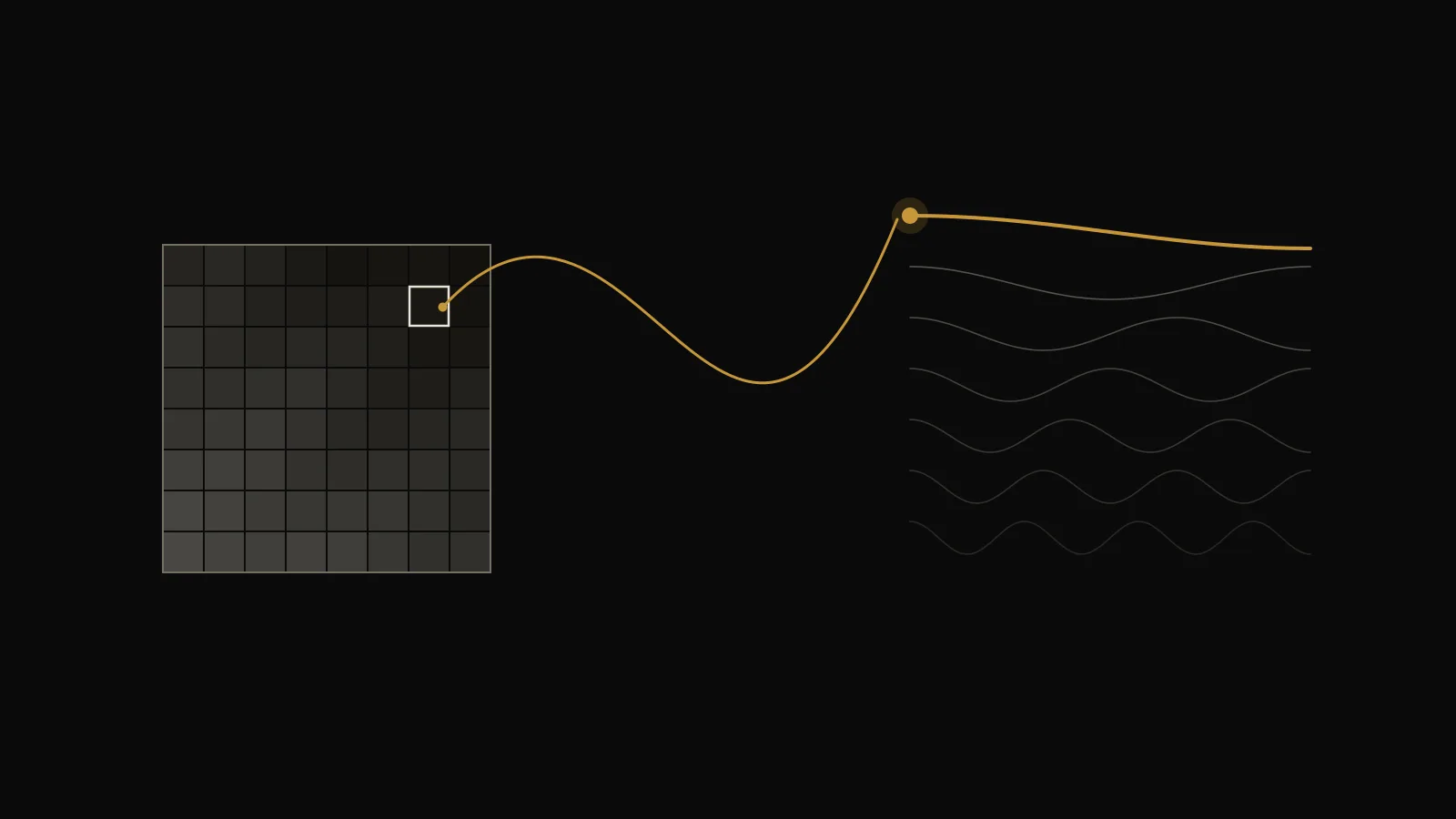
In early 1972, an engineer at Kansas State University asked the US government for money to study what he called a “cosine transform.” One reviewer, he later recalled, thought the whole idea seemed “too simple.”[1] Half a century on, a version of that simple idea is how a phone squeezes a photograph into a message, and how a video call fits through an ordinary connection.
The story starts with a baby’s face. In 1957, at the US National Bureau of Standards, a computer scientist named Russell Kirsch used a rotating drum scanner to turn a photograph of his three-month-old son, Walden, into numbers that a computer called SEAC could store.[2] The picture measured 176 pixels on a side. It is remembered as the first digital image.[3]
Kirsch had started from a question that the institute still quotes: “What would happen if computers could look at pictures?”[2]
One answer arrived quickly. Pictures are enormous. Every dot in a photograph becomes a number, and there are a great many dots. Decades later, the engineer who chaired the international committee on picture compression put it plainly: a single colour picture at television resolution came to “on the order of one million bytes,” and a 35mm photograph needed ten times that.[4]
If you have sent a photo, watched a video or joined a video call today, you have used the way the world solved that problem. Its key piece was published in four pages in 1974, by a man who had grown up on his grandfather’s stories about America.
Act I: The Grandfather’s Stories
Nasir Ahmed was born in Bangalore, India, in 1940, and raised by his maternal grandparents.[5] His grandfather, M. Ali Khan, was an electrical engineer. From 1919 to 1922 he had worked in the United States for General Electric, sent to help improve the electrification of the province of Mysore. He told his grandson stories of his time there and urged him to go.[6]
After retiring, the grandfather returned to Bangalore in 1960. There he met an American engineering consultant hired by the government of Mysore. The consultant came from Albuquerque, New Mexico, and spoke proudly of its university.[6] When Nasir started looking at graduate schools, he set his sights on the University of Washington, where a cousin was studying physics. His grandfather stepped in. “UNM is the place you have to go,” he said, meaning the University of New Mexico.[6]
In 1961, after earning a degree in electrical engineering in Bangalore, Ahmed left India for Albuquerque.[5] In September 1962, as a graduate student, he was put in charge of a group of international students arriving on campus. One of them was Esther, an English major from Argentina on a scholarship. She became his wife.[6]
He earned his master’s degree in 1963 and his doctorate in 1966. He then spent two years at Honeywell in Minnesota, because he wanted experience of industry before teaching, and in 1968 he joined the faculty of Kansas State University, in the small city of Manhattan, Kansas.[1]
Act II: The Perfect Method Nobody Could Use
By the late 1960s, many researchers were trying to make pictures smaller. Many of them used what mathematicians call a transform: a way of rewriting a long list of numbers in a different form, in which the important information is easier to find. A useful comparison is music. A recording of a chord is a long list of air-pressure measurements, but the same chord can also be written as just a few notes.
One transform, known as the Karhunen-Loève transform, was the best in theory. It packed a picture’s information into the fewest numbers. But it had a flaw that Ahmed could not stop thinking about. “What intrigued me was that the KLT was indeed the optimal transform … and yet there was no efficient algorithm available to compute it,” he wrote in 1991.[1] The perfect method was too slow to use.
Ahmed wondered whether something close to perfect could be fast. His hunch was cosines: the smooth, repeating waves familiar from school trigonometry. He had noticed that cosine waves closely resembled the building blocks of the perfect transform for the kind of data that pictures produce.[1] Cosines also had an advantage that the perfect method lacked. They were the same for every picture, and they could be computed quickly with a well-known shortcut, the fast Fourier transform.[7]
“This was in early 1972, and I wrote a proposal to the National Science Foundation (NSF) to study a ‘cosine transform’ using Chebyshev polynomials,” he recalled. The answer was no. “Much to my disappointment, NSF did not fund the proposal; I recall one reviewer’s comment to the effect that the whole idea seemed ‘too simple.’”[1]
Half a century later, he still remembered the conviction. “I had a strong intuition that I could find an efficient way to compress digital signal data,” he said in 2024.[5] Without the grant, Ahmed and Esther made the salary he earned during the nine-month school year last through the summer, so that he could keep working.[5]
He did not work alone. He brought in one of his PhD students, T. Natarajan, and a friend, K. R. Rao, a professor at the University of Texas at Arlington who had studied engineering in Madras, now Chennai.[8] “We worked with no fanfare on huge IBM machines with punched cards to develop a working DCT algorithm,” Ahmed said later. “Two guys from India coordinating the development of this mathematical function in the middle of Kansas!”[6]
The results surprised them. “The results that we got appeared too good to be true,” Ahmed wrote. At a conference in New Orleans, he took them to Harry Andrews of the University of Southern California, whose group had helped develop the standard tests for such methods. Andrews suggested another test and sent a computer program to run it. “The results again showed that this transform performed better than all the others, and its performance compared very closely with that of the KLT,” Ahmed wrote. “When I sent the results back to Harry Andrews, he suggested that I publish them.”[1]
The paper reached the journal IEEE Transactions on Computers on 29 January 1973 and was published in January 1974, under the title “Discrete Cosine Transform.”[7] It was four pages long. They had sent it in as a short “correspondence” item, Ahmed recalled, “in order to get it published with minimum delay.”[1]
Its claim was modest and precise. The new transform came close to the perfect one, closer than its rivals, and it could be computed quickly. In the authors’ words, “the performance of the DCT compares more closely to that of the KLT relative to the performances of the DFT, WHT, and HT,” three of the other transforms then in use.[7]
Here is the idea in plain terms. In most photographs, neighbouring dots are similar: a patch of sky or skin changes slowly from one dot to the next. The DCT describes a small patch of picture as a mixture of waves, from slow and broad to fast and fine. For a typical patch, nearly all of the picture is carried by a few slow waves. The fast waves, which carry the finest detail, are tiny or zero. Keep the important numbers, round off the rest, and the patch can be rebuilt almost exactly from far less data.[4]
Act III: Twelve Methods, One Winner
For a decade, the DCT was one good idea among many. Then the world needed a single way to compress photographs, so that a picture made on one machine could be opened on any other.
In November 1986, a group of experts met in Parsippany, New Jersey, and formally created the Joint Photographic Experts Group. The “joint” referred to a collaboration between two international standards bodies, the CCITT, now part of the International Telecommunication Union, and ISO.[9] The group gave its initials to the format we still use: JPEG.
The committee ran a contest. “In June 1987, JPEG conducted a selection process based on a blind assessment of subjective picture quality, and narrowed 12 proposed methods to three,” wrote Gregory Wallace, of Digital Equipment Corporation, who chaired the committee from 1988. In January 1988, in Copenhagen, a second, more rigorous round decided it. The winning proposal, “based on the 8x8 DCT, had produced the best picture quality.”[9][4]
This is how JPEG works, in plain terms. The picture is cut into tiles of 8 by 8 dots. The DCT rewrites each tile as 64 waves. Then comes the step that makes files small: each wave is rounded, gently for the broad patterns that the eye notices and roughly for the fine ones it does not. In Wallace’s words, the goal is “to discard information which is not visually significant.” By his account, the best methods of the day could shrink typical images to between a tenth and a fiftieth of their size “without visibly affecting image quality.”[4]
Two more decisions helped it spread. In 1989 the committee agreed that the basic form of JPEG should be free of royalties.[9] And in 1990 a programmer named Tom Lane obtained the draft specification and began writing free software to read and write JPEG files. His Independent JPEG Group released its first version on 7 October 1991.[10] Anyone could build it into a product. István Sebestyén, who helped lead the work on the telecommunications side, later concluded that the free availability of this code “contributed significantly to the success” of the standard.[9]
In 1991, before the standard was even approved, Ahmed looked back on his four pages. “Little did we realize at that time that the resulting ‘DCT’ would be widely used in the future!” he wrote. “It is indeed gratifying to see that the DCT is now essentially a ‘standard’ in the area of image data compression via transform coding techniques.”[1]
The International Telecommunication Union approved the JPEG standard on 18 September 1992.[11] Wallace had written that the real measure of success would come when JPEG images were “taken for granted as ‘just another data type,’ as text and graphics are today.”[4] That is what happened.
Success attracted a claim. In 2002, a company called Forgent Networks said that a 1987 American patent it owned covered part of JPEG, and it went on to collect more than $110 million in licence fees and settlements. A court ruled in June 2006 that the patent applied only to video. It expired that October, and in November Forgent settled its remaining cases for about $8 million. The format itself carried on.[12]
Act IV: Pictures That Move
A video is a series of still pictures shown quickly, one after another. That made Ahmed’s transform just as useful for moving images. Video systems send one picture, then mostly send the changes, and use a DCT to pack those changes into as few numbers as possible.[15]
The international standard for digital video calls approved in 1990, H.261, was designed for videophones and videoconferencing over the new digital telephone lines. Its text is explicit: “Transmitted blocks are first processed by a separable two-dimensional discrete cosine transform of size 8 by 8.”[16]
Then came the Moving Picture Experts Group, MPEG. Its first standard, approved in 1992, was used on the Video CD, which in the second half of the 1990s “spread especially in South East Asia,” according to Leonardo Chiariglione, who led the group.[17] The same standard included the audio format that became famous as MP3. For MP3, its designers added a close cousin of the DCT, known as the modified discrete cosine transform, “to increase the frequency resolution.”[15] The idea behind it had been published by John Princen and Alan Bradley in 1986.[18]
The second MPEG standard, completed in November 1994, carried digital television by satellite, cable and aerial, and filled DVDs.[19] Its successor, published in 2003 and known as H.264, replaced the original DCT with a version that computers could calculate exactly, using whole numbers, “with similar properties as a 4×4 DCT.”[19] Later standards, including HEVC in 2013 and AV1, still build their pictures from DCT-style waves, alongside a few other shapes.[20][21] The internet telephony format Opus, standardised in 2012 for voice calls and videoconferencing, uses the modified DCT too.[22]
“Only a few image-compression standards not using DCT exist today,” Touradj Ebrahimi, chair of the JPEG committee, said in 2024.[5] By then video was the largest single kind of traffic on the internet. The network company Sandvine measured it at 65 percent of all internet traffic in 2022[23], and Ericsson estimated that video made up around 75 percent of all mobile data traffic at the end of 2025.[24]
Act V: The Thread
Read from end to end, the story of the DCT turns on a word that was meant as a criticism.
The reviewer who found the idea “too simple” was, in a sense, right. The DCT was simple. It did not adapt itself to each picture, as the perfect method did. It used the same cosine waves every time. That simplicity is a large part of why it won. A method that is the same every time can be built into chips, written into a standard, tested by a committee and copied by any programmer. The perfect method, which had to be worked out afresh, never travelled. The simple one went everywhere.
The second ingredient was openness, and it came from other people. JPEG’s basic form was royalty-free. Tom Lane’s free code put it into every kind of software. Forgent’s claim came a decade after the standard and ended when its patent expired.
Ahmed himself made almost nothing from it. Once the paper was published, it belonged to the journal. “People always say that I must have made a lot of money from the idea, but in fact in those days, there was no money,” he said.[6]
Recognition came slowly. K. R. Rao spent 54 years teaching at the University of Texas at Arlington and died in 2021, aged 89.[25] Ahmed retired from the University of New Mexico in 2001 as professor emeritus.[26] In 2026, more than fifty years after the paper, he received the IEEE Fourier Award “for contributions to the digital revolution by developing the Discrete Cosine Transform,”[27] was elected to the US National Academy of Engineering,[26] and was awarded the Prince Philip Medal by Britain’s Royal Academy of Engineering, which described him as the inventor of an “invisible algorithm.”[28]
The pattern is an old one in the history of technology. The most widely used inventions are often the ones nobody sees. Every photograph opens, every video plays, and the mathematics that made them small enough to send stays out of sight.
Act VI: Nasir and Esther
During the pandemic, the producers of the American television drama This Is Us were developing a storyline in which a family stayed together over video calls. They wondered who had first made video chat possible, and their search led them to Nasir Ahmed. They emailed him.[6]
He thought it might be a scam, and asked his son, Michael, a lawyer in Las Vegas. Michael was wary too. “Mom and Dad, it’s not true. Don’t respond,” he told them. When the producers heard nothing, they called Michael directly, and he told his parents: “You won’t believe it. This is for real!” The producers talked to Nasir and Esther over Zoom.[6]
On 16 February 2021, the episode told their story, from the day in Albuquerque when a young engineer from Bangalore met a student from Argentina.[29] Ahmed had one correction. “The actors, creator, director and all the ‘This is Us’ staff did a fantastic job portraying us, except my wife never smoked!” he said.[6]
Before the credits, viewers saw photographs of the real Nasir and Esther, and a final line. “You don’t know his name, but Nasir and his team are responsible for keeping us connected today.”[6]
“Never at that time did I know the impact that it would have even today,” Ahmed said the following year.[6] The first digital picture had been a baby’s face, 176 pixels across. Today, grandparents everywhere see their grandchildren on small screens, in pictures made small enough to send by an idea once thought too simple to fund.
Thread crossings
- This thread crosses The Scientists Who Taught Machines to Guess the Next Word in 1957.
- This thread crosses The Neural Network’s 70-Year War: From 1943 to AlexNet in 1957.
- This thread crosses The Database Idea IBM Could Not Afford to Build in 1968.
Conversation
No comments yet. Memories, sources and questions are all welcome. To write about one moment, open its knot on the thread and choose “Add a note”.
Sources
Suggest a correction or a source
Papers
- N. Ahmed, “How I Came Up with the Discrete Cosine Transform,” Digital Signal Processing 1, 4–5, 1991. https://doi.org/10.1016/1051-2004(91)90086-Z
- G. K. Wallace, “The JPEG Still Picture Compression Standard,” Communications of the ACM 34(4), April 1991 (revised version, December 1991). https://www.comp.nus.edu.sg/~cs5342/readings/wallace.pdf
- N. Ahmed, T. Natarajan and K. R. Rao, “Discrete Cosine Transform,” IEEE Transactions on Computers C-23(1), 90–93, January 1974. https://doi.org/10.1109/T-C.1974.223784
- I. Sebestyén, “Some little-known aspects of the history of the JPEG still picture-coding standard,” ITU Journal: ICT Discoveries 3(1), June 2020. https://www.itu.int/en/publications/Documents/tsb/2020-ITU_Journal-ICT_Discoveries/Vol3-No1/files/basic-html/page145.html
- J. Princen and A. Bradley, “Analysis/Synthesis filter bank design based on time domain aliasing cancellation,” IEEE Transactions on Acoustics, Speech, and Signal Processing 34(5), 1986. https://doi.org/10.1109/TASSP.1986.1164954
- T. Wiegand et al., “Overview of the H.264/AVC Video Coding Standard,” IEEE Transactions on Circuits and Systems for Video Technology 13(7), July 2003. https://doi.org/10.1109/TCSVT.2003.815165
- J. Han et al., “A Technical Overview of AV1,” arXiv 2008.06091. https://arxiv.org/abs/2008.06091
- G. J. Sullivan et al., “Overview of the High Efficiency Video Coding (HEVC) Standard,” IEEE Transactions on Circuits and Systems for Video Technology 22(12), December 2012. https://doi.org/10.1109/TCSVT.2012.2221191
Official records
News
Web
- Kimberly Delker, “Picture Perfect,” Mirage magazine, University of New Mexico, 2 May 2022. https://mirage.unm.edu/?p=4788
- Independent JPEG Group. https://www.ijg.org/
- International Telecommunication Union. https://www.itu.int/rec/T-REC-T.81-199209-I/en
- Associated Press via NBC News. https://www.nbcnews.com/news/amp/wbna15534260
- JPEG. https://jpeg.org/items/20191213_press.html
- W3Techs. https://w3techs.com/technologies/details/im-jpeg
- Riding the Media Bits. https://ride.chiariglione.org/mpeg-1-inside/
- International Telecommunication Union. https://www.itu.int/rec/T-REC-H.261
- Leonardo Chiariglione. https://leonardo.chiariglione.org/6-1-what-has-been-done/
- IETF. https://www.rfc-editor.org/rfc/rfc6716.txt
- PR Newswire. https://www.prnewswire.com/news-releases/sandvines-2023-global-internet-phenomena-report-shows-24-jump-in-video-traffic-with-netflix-volume-overtaking-youtube-301723445.html
- Ericsson Mobility Report. https://www.ericsson.com/en/reports-and-papers/mobility-report/dataforecasts/mobile-traffic-update
- University of Texas at Arlington. https://www.uta.edu/academics/schools-colleges/engineering/about/news/2021/01/21/01-rao-obit
- University of New Mexico. https://mirage.unm.edu/unm-professor-emeritus-nasir-ahmed-elected-to-the-national-academy-of-engineering/
- IEEE. https://corporate-awards.ieee.org/recipient/nasir-ahmed/
- Royal Academy of Engineering. https://raeng.org.uk/news/inventor-of-the-invisible-algorithm-at-the-heart-of-global-digital-communications-awarded-the-biennial-prince-philip-medal/
- TVLine. https://tvline.com/2021/02/16/this-is-us-recap-season-5-episode-8-madison-kevin-twins-born
Cite this story
- APA
- Chandrayan, P. (2026, November 27). The Idea a Reviewer Called Too Simple to Fund. The Long Thread. https://thelongthread.in/stories/the-idea-a-reviewer-called-too-simple-to-fund
- MLA
- Chandrayan, Pramod. “The Idea a Reviewer Called Too Simple to Fund.” The Long Thread, 27 Nov. 2026, thelongthread.in/stories/the-idea-a-reviewer-called-too-simple-to-fund.
- Chicago
- Chandrayan, Pramod. “The Idea a Reviewer Called Too Simple to Fund.” The Long Thread, November 27, 2026. https://thelongthread.in/stories/the-idea-a-reviewer-called-too-simple-to-fund.